






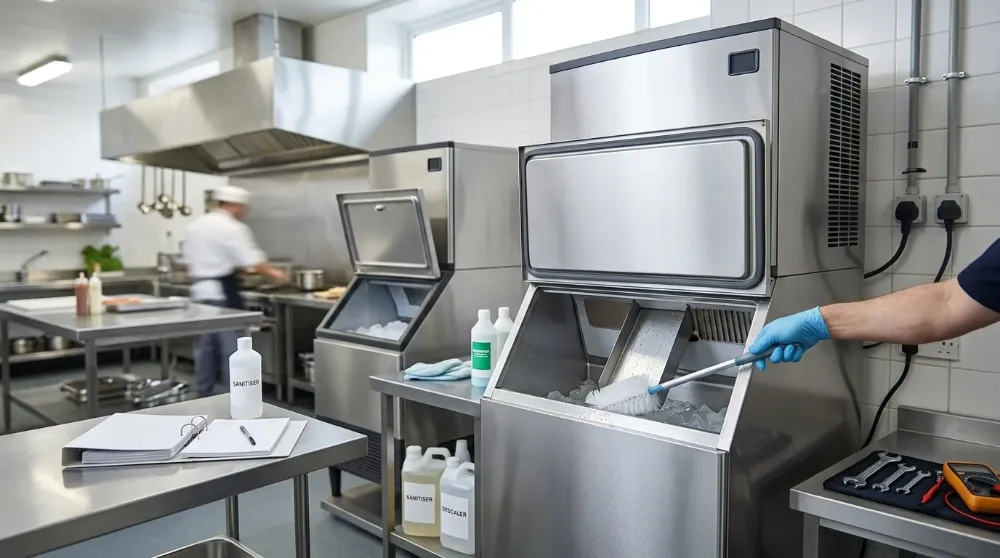
Commercial ice maker cleaning and maintenance matters because the ice you serve is a ready-to-eat food, and reliability affects service in busy kitchens and bars.
You protect customers and your reputation by keeping the machine hygienic, producing consistent ice, and reducing breakdowns that lead to downtime and call-outs. The most robust approach is to make ice-machine hygiene part of your HACCP-based controls: clear routines, clear responsibilities, and simple records of cleaning, servicing, and corrective actions.
Good maintenance is also about knowing the boundary between staff-safe tasks (cleaning accessible food-contact parts and basic checks) and tasks that should be handled by a qualified service technician (anything involving internal components beyond the operator manual, refrigeration systems, electrics, or performance faults).
Why ice machines need a planned cleaning routine
Ice makers tend to fail in predictable ways: limescale, biofilm, blocked airflow, and standing water can quietly reduce output and create hygiene risks. Even when ice looks “fine”, contamination can spread once it gets into the water path or bin. Risk typically increases in:
- Hard-water areas (more mineral scale)
- Hot/greasy service zones (airborne grease and dust can affect airflow and cleanliness)
- High-volume service (bin access and handling increase cross-contamination risk)
HACCP and Irish hygiene expectations (what you need to be able to show)
In Ireland, food businesses are expected to maintain appropriate hygiene standards and operate procedures based on HACCP principles, as set out in EU hygiene rules and Irish implementing legislation and guidance. For practical reference points, many operators rely on the Food Safety Authority of Ireland (FSAI) resources, including the FSAI hygiene of foodstuffs guidance and the Guide to Good Hygiene Practice.
For an ice machine, “compliance” usually comes down to being able to demonstrate:
- A written cleaning schedule for the ice machine, bin, scoop, and surrounding area
- Records showing the schedule is followed (date, person, task done)
- Corrective actions when checks fail (e.g., discard ice, re-clean, escalate for service)
- Staff instruction/training for safe chemical use and hygienic handling
General hygiene duties are reflected in European Communities (Hygiene of Foodstuffs) Regulations 2006 (S.I. No. 369/2006), alongside EU hygiene requirements summarised by the FSAI.
Cleaning vs descaling vs sanitising (and why it matters)
These terms are often used interchangeably on shift, but they target different problems:
- Cleaning removes visible soil (dust, spills, sugar residues, grime). Cleaning is usually the first step before any disinfectant can work properly.
- Descaling removes mineral build-up (limescale) from water-contact surfaces. Scale can reduce heat transfer and restrict water flow, affecting both ice quality and reliability.
- Sanitising/disinfecting reduces microbial contamination (biofilm, bacteria, yeasts, mould risks) on food-contact parts. This supports food safety and helps prevent odours and off-tastes.
Always use products and steps that the manufacturer approves for your specific machine, and follow label instructions. Stronger chemicals or “extra dose” approaches can damage components and may still fail to remove biofilm if the underlying cleaning step is poor.
What staff can usually do safely in-house
In-house routines work best when they’re simple, repeatable, and tied to a rota. Keep tasks to what your operator manual allows and what can be done without opening technical panels or interfering with internal systems.
Daily: quick hygiene reset (high-touch and handling points)
- Wipe external touchpoints (buttons, handles, door surfaces) with a food-safe sanitiser.
- Check that the bin lid closes properly and isn’t being left open during service.
- Confirm the ice scoop is clean and stored hygienically (not buried in the ice).
- Look for obvious issues: spills, standing water around the unit, or signs of leaks.
Weekly: empty, wash, and sanitise the bin and scoop
- Discard ice (don’t “top up” over old ice when hygiene is in doubt).
- Wash the bin liner and scoop using suitable detergent, then sanitise and allow to air-dry fully.
- Clean surrounding areas so splash-back, dust, and sticky residues don’t re-contaminate handling points.
Keep airflow and access areas “boring”
- Keep vents and air intakes unobstructed; don’t stack boxes against the machine.
- If your model has an accessible air filter or grille that the manual classifies as an operator-clean item, keep it clean on schedule.
Avoid tasks that involve electrics, refrigeration components, non-operator panel removal, internal adjustments, or any internal descaling/sanitising programme unless the manufacturer explicitly describes it as an operator task and you can do it safely within your procedures.
How often should an ice machine be cleaned for HACCP?
There is no single legally fixed interval that suits every site. A defensible HACCP approach is to:
- Start with the manufacturer’s recommended intervals for cleaning, descaling, and sanitising.
- Adjust frequency based on your risk factors (water hardness, heat/grease exposure, service volume, seasonal peaks).
- Review the schedule when you see repeat issues (scale, odours, slow production, clumping, complaints).
What matters most in an inspection is that your schedule is written, followed, recorded, and updated when conditions change.
HACCP documentation: simple records that hold up in inspections
Inspection-ready documentation doesn’t have to be complicated; it has to be consistent. Useful records include:
- Cleaning logs: date/time, task (bin/scoop/external surfaces), initials/signature.
- Chemicals used: product name and any relevant notes the label/manual requires (avoid over-detailing if it creates errors).
- Corrective actions: what triggered it (e.g., odour/cloudy ice), what was done (discarded ice, cleaned/sanitised), who signed off, and whether service was requested.
- Service reports from your technician/contractor (work done, observations, parts replaced if applicable).
If you use standard record templates, the FSAI Safe Catering Pack record books are commonly used by food businesses.
Warning signs: when hygiene or maintenance is slipping
Train staff to treat changes in ice quality as a food-safety and service risk, not just a “machine issue”. Common early indicators include:
Hygiene red flags
- Musty/damp odours from the bin or ice
- Off-tastes (chemical, stale, or “fridge” flavour)
- Cloudy ice that’s new or worsening
- Slime/biofilm seen on accessible parts
Performance and reliability red flags
- Slower production or longer freeze times
- Soft, hollow, or misshapen ice (a sign something has changed—often water flow/scale-related)
- Clumping in the bin that’s worse than usual
- Unusual noises (rattling, grinding, louder operation than normal)
- Recurring alarms/fault codes
What to do when you spot a red flag
- Don’t serve suspect ice. Discard it.
- Log the issue as a corrective action in your HACCP records.
- Clean and sanitise the bin and the food-contact parts your manual allows.
- Escalate early if the issue persists after routine cleaning, or if there are leaks, overheating signs, electrical concerns, or repeated faults—these are technician jobs.
Professional servicing: what it’s for (and how it supports HACCP)
Professional servicing helps cover what staff shouldn’t attempt: deeper internal hygienic cleaning steps where applicable, descaling/sanitising procedures specified by the manufacturer, and diagnosis of reliability issues. From a HACCP perspective, service reports provide evidence that maintenance is planned and that problems are addressed rather than ignored.
Where you rely on third-party service support, keep service records on-site alongside cleaning logs so you can show both day-to-day control and planned maintenance.
Related reading
- Commercial Ice Maker Types and Ice Shape Uses
- Commercial Ice Maker Buying Checklist and Sizing
- Commercial Vacuum Packer Cleaning and Maintenance
- Commercial Beer Fridge Temperature Settings for Service
FAQ: Do ice machines need to be included in my HACCP plan in Ireland?
Yes. If you serve ice in drinks, display food on ice, or use ice in food prep, it’s part of your food operation and should be covered by your HACCP-based procedures. In practice that means identifying hazards (microbiological and physical contamination are common examples), setting controls (cleaning/sanitising routines, handling rules, and maintenance escalation), and keeping records that show the controls are carried out in line with your system and relevant FSAI guidance.
Browse: Ice makers