



Commercial Ice Maker Types and Ice Shapes for Irish Businesses
Choosing the right commercial ice maker matters because ice quality, output, and reliability directly affect service speed, drink presentation, and food safety in Irish hospitality and healthcare settings.
You are balancing practical constraints like water quality, hard-working peak periods, limited back-of-house space, and Ireland’s humid or coastal environments where corrosion risk and ventilation needs can shape what will perform well. You also want a setup that matches how you serve, whether that is bagging ice for events, keeping seafood displays topped up, or protecting blender performance, while staying on top of cleaning routines and running costs such as energy use and filter changes.
By understanding how different machine formats are installed and sized, what maintenance looks like in day-to-day operations, and what local warranty and service support is available in Ireland, you can choose equipment that keeps ice supply steady without creating avoidable downtime. Start by lining up the ice shape with the job it needs to do in your business.
Types of Commercial Ice and Their Uses
Pick commercial ice based on the drink you serve, how fast you need chilling, and how tidy you need service to stay during a rush. Ice types are standardised shapes made by different evaporator and harvest systems, and they suit everything from cocktail presentation to food displays and healthcare hydration. In Irish bars, restaurants, hotels, care settings, and food production, the “right” ice is the one that matches your melt rate, handling method, and hygiene routine, because the same rated machine capacity can feel very different depending on ice type, bin storage, and how often the bin is opened during busy service, so it pays to match the ice to your day-to-day workflow.
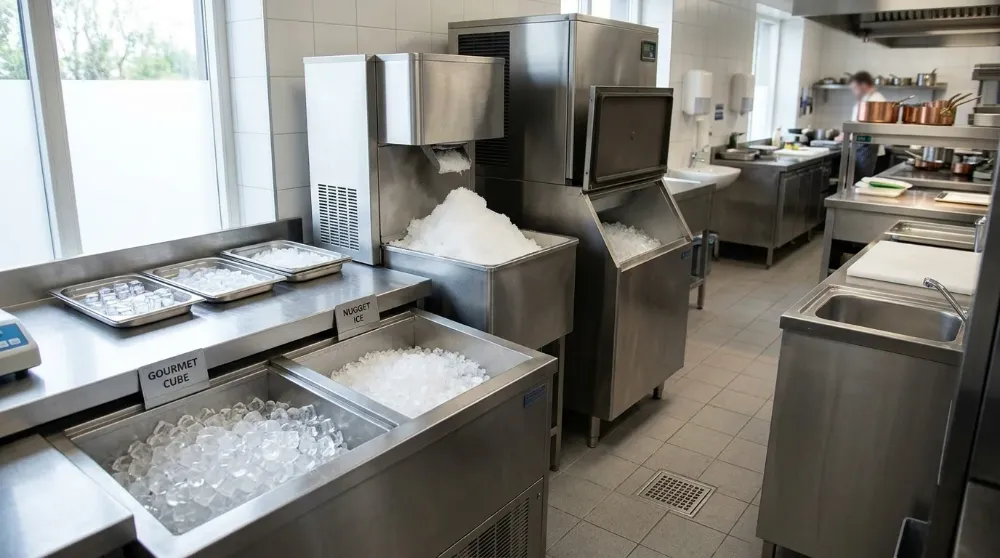
Matching ice shape to the job (Irish examples)
- Cube: spirits, mixers, table water
- Flake: fish counters, salad bars, rapid cooling
- Nugget: soft drinks, chewing ice, patient hydration
- Bullet/spray: high-volume pubs, blended drinks
- Hollow: fast cooling in smaller glasses
- Gourmet: premium cocktails, slow melt, strong presentation
If you are choosing equipment, it helps to know that many ranges are sold by ice style, so starting with the shape usually narrows you into the right commercial ice maker category quickly.
Frequently Asked Questions About Commercial Ice Types in Ireland
What are the main types of commercial ice used in Ireland?
The most common commercial ice types you will see in Ireland are cube (solid or partially hollow), flake, nugget, and bullet style ice. Some venues also choose gourmet or “premium” cubes for cocktail work where appearance and slower melt matter. The best fit depends on your service style, storage setup, and whether ice is used mainly for drinks, food display, or rapid chilling.
Which ice is best for cocktails in pubs and bars?
For cocktails, a larger, clearer cube (often sold as gourmet or premium cube) is usually the go-to because it melts more slowly and keeps the drink from watering down as quickly. Standard cubes also work well for high-volume mixed drinks where speed matters more than presentation. If you run a cocktail-led bar, the visual side and melt rate are worth treating as a spec, not an afterthought.
What ice should I use for fish counters and food displays?
Flake ice is widely used for seafood displays and deli counters because it packs around product, holds temperature well, and presents neatly. It is also popular for rapid cooling and some food production tasks. If you are using ice for any food contact application, keep your HACCP controls, cleaning schedule, and scoop handling tight, as hygiene and cross-contamination risk tend to be the real deciding factors.
Is nugget ice suitable for healthcare and care homes?
Nugget ice is commonly used for soft drinks and for people who prefer chewable ice, which is why it can suit hydration support in some care settings. What matters most is safe handling, a consistent cleaning routine, and making sure staff are using a scoop rather than hands or glassware in the bin. For healthcare or medical environments, you should also align your process with your own infection prevention and HACCP policies.
Does ice type affect machine output and running in busy service?
Yes, ice type can change how a machine feels in real service. Different ice styles have different densities and melt rates, and storage losses can be higher if the bin is opened constantly during peak hours. Even if two machines have similar daily production figures, the practical result can differ once you factor in ambient temperature, bin size, and how fast ice is being drawn down during a Friday night rush.
How do I choose between a self-contained and modular ice machine?
A self-contained unit has the ice maker and storage bin in one footprint, which suits many Irish cafés, bars, and smaller kitchens where space is tight and install is straightforward. Modular heads sit on a separate storage bin, which can make sense for higher-volume venues that need more storage and a bit more flexibility. The right choice comes down to your daily demand, available space, ventilation, and how you plan to manage peak periods without running out.
Choose the Right Commercial Ice Machine for Your Venue
If you want ice that keeps up with service and suits your drinks or food display, start by choosing the ice shape you actually need day to day, then size the machine and storage to match your busiest periods. Browse Caterboss commercial ice makers for cube, flake, and nugget options, and if you are unsure on capacity or bin sizing, contact the Caterboss team for trade-first advice and options, including flexible finance subject to approval and partner terms. Useful starting points are the Ice Makers range and the Commercial Ice Cube Machine category for cube-led setups.
Choosing the Right Ice Maker for Your Irish Business
Work out how much ice you actually go through on a normal trading day, then pick the ice shape that suits what you serve (cocktails, soft drinks, seafood display, or patient hydration). Match the machine style (undercounter, modular head plus bin, or countertop) to your available space, power supply, and cleaning routine. Confirm water filtration, drainage, and airflow so the unit keeps up even during busy Irish summer trade, because a poorly sited machine will never hit its quoted output and usually shows up later as breakdowns, scale, or hygiene issues.
1. Size it for your busiest day, not your quiet Tuesday
Work back from peak covers and drink throughput: bars need fast-recovering cubes, hotels often need higher storage for breakfast and events, and healthcare settings prioritise hygienic, frequently replenished ice. If you are in a hard-water area, limescale can reduce output over time, so it is worth checking your local hardness and allowing for filtration and descaling as part of the real capacity plan. Uisce Éireann notes that hard water is a natural characteristic of much of Ireland’s drinking water supply, and it is safe to drink, but it can be tougher on equipment without treatment or maintenance schedules in place. See Uisce Éireann water hardness guidance for local context, since water conditions often influence the practical spec you end up needing.
2. Choose the right build: undercounter vs modular, air-cooled vs water-cooled
Air-cooled units need clear ventilation, so treat siting like you would any appliance airflow check and avoid boxing the condenser in under a tight counter. Modular heads with a separate bin tend to suit higher volume venues because you can scale storage, while undercounter machines suit tighter bars and cafés where footprint matters and you want ice close to service. Where hygiene is a priority, especially in healthcare, it is also worth aligning your choice with your infection prevention and control approach, as Irish HSE/HPSC guidance on water systems includes ice-making machines among water outlets/equipment requiring appropriate controls and cleaning routines. The operational reality is that the “right” machine is the one you can site correctly and keep clean without it becoming a daily battle.
Frequently Asked Questions About Choosing a Commercial Ice Maker in Ireland
How much ice does a commercial ice maker produce per day?
Output is usually quoted as kilograms per 24 hours, measured under specific test conditions, and the real figure can be lower if your kitchen is warm, ventilation is tight, or the condenser is dirty. In Irish premises, a busy bar in summer, a hot pass, or a small back bar with poor airflow can all knock performance, so it is sensible to size with headroom and focus on airflow, filtration, and maintenance rather than taking the brochure number at face value.
What type of ice is best for pubs, bars, and cocktail service?
For pubs and mixed drinks, full cube or dice cube is the common all-rounder because it melts slower and holds up in a busy glasswash rotation. For cocktails, many operators prefer solid, clear cubes for presentation and slower dilution, while nugget or flake styles can suit soft drinks, blended drinks, and quick chilling. The practical choice comes down to what you serve most, how fast you need recovery during peak, and whether you can keep the machine cleaned and filtered consistently.
Do I need water filtration for an ice machine in Ireland?
In most cases, yes. Even when your mains water is perfectly safe, scale and sediment can shorten component life, reduce output, and affect taste and clarity, and hard water is common across large parts of Ireland. Uisce Éireann provides local information on water hardness, which is a useful starting point for deciding on filtration and descaling routines. See Uisce Éireann water hardness guidance.
What is the difference between air-cooled and water-cooled ice machines?
Air-cooled machines dump heat into the room through a condenser and need good ventilation around the unit, making them sensitive to tight cabinetry and warm back bars. Water-cooled machines use water to remove heat and can be more stable in hot, enclosed spaces, but they can use significantly more water and require appropriate plumbing. Your choice usually comes down to airflow and ambient temperature constraints, your water supply and drainage setup, and the running cost trade-off that makes sense for your site.
Are ice machines a hygiene risk in healthcare settings?
They can be if they are not managed properly. Irish HPSC guidance on water systems includes ice-making machines among the outlets/equipment that need appropriate risk assessment, controls, and cleaning routines in healthcare settings. This is also where dispenser style, scoop handling, staff training, and documented cleaning schedules become just as important as the machine spec itself. See the HPSC guidance document for healthcare-focused context.
What installation checks matter most before you buy a commercial ice maker?
Confirm electrical supply, available ventilation clearance, and whether the unit needs a gravity drain or a drain pump, as well as where the drain will run to. Check that the location stays within the manufacturer’s ambient temperature range and that you can access the unit for cleaning and servicing without dismantling half the bar. Getting these basics right tends to make the difference between a unit that quietly does its job and one that becomes a recurring service call.
Size and Spec Your Commercial Ice Maker with Confidence
If you want a trade-grade ice machine that keeps up in real Irish service, start by matching daily output, storage, and ice type to your busiest hours, then sanity-check the site for ventilation, drainage, and water filtration. Speak to the Caterboss team for practical buying advice, delivery across Ireland, and finance options where suitable and subject to approval, so you can choose an ice maker that fits your space and your volume without nasty surprises later.
Installation and Space Requirements
Measure your available footprint, service clearances, and your drain, water, and power points before you commit to a machine. Then choose the format that suits the reality of the site: undercounter for tight bar stations, self-contained for simpler plug-in style installs, and modular head-and-bin setups for higher-volume demand. Set ventilation gaps exactly as the manufacturer states and leave proper access for cleaning, descaling, and servicing, not just “does it fit”. If the room runs warm or the unit is boxed-in behind joinery, sort airflow before you buy because restricted ventilation is where a lot of callouts start.
1. Match the machine type to your space
Undercounter units combine the ice maker and storage in one cabinet, making them a solid fit for busy pubs, cafés, and small bars where every centimetre matters. Self-contained machines are similar in concept but are often larger and freestanding, so you typically need a bit more floor space and more clearance around the cabinet. Modular ice machines split the ice “head” from a separate storage bin, which means more height, more pieces to position, and a bit more planning for delivery and installation access, particularly in older Irish buildings with tight doorways and back-of-house routes.
A quick on-site measure with the door swing and service access in mind saves you from buying a unit you cannot properly maintain once it is in place.
2. Plan ventilation and heat rejection
Ventilation matters because ice machines reject heat into the room, and performance drops fast when warm air gets trapped around the condenser. In simple terms, if the machine cannot breathe, it struggles to make ice efficiently and you will see higher running strain and more breakdown risk. Always follow the clearances in the manufacturer manual, and be realistic about ambient temperature in a closed bar back, small kitchen, or plant room.
Ventilation is also treated as a core building performance requirement in Ireland, which is reflected in Technical Guidance Document F (Ventilation). That does not replace a competent installer’s responsibilities or the manufacturer’s instructions, but it can be a helpful reference point when you are designing a fit-out or refurb and trying to avoid hot, poorly ventilated equipment zones.
Once airflow is workable, the practical question becomes whether your services are in the right place to connect the unit safely and keep it hygienic.
3. Confirm services and access before delivery
You will need a safe electrical supply, a potable water feed, and a suitable drain with the correct fall, along with isolation points you can actually reach. For commercial sites in Ireland, it is worth having a qualified electrician and a competent installer confirm supply and protection requirements against the machine spec, rather than guessing from a plug type. Water quality also matters more than most people think because hard water and scale can shorten service intervals, so plan for filtration or treatment where needed based on local supply.
Leave enough front and side access to clean and sanitise the bin area, descale the system, change or clean filters, and pull the unit out without shutting your operation down for half a day. That access mindset tends to influence what style of machine makes sense for your bar or kitchen day-to-day, especially when you factor in maintenance routines and hygiene expectations.
Frequently Asked Questions About Ice Machine Installation and Space Requirements in Ireland
Do I need a drain for a commercial ice machine?
Most commercial ice machines need a reliable drain connection because they purge water during harvest cycles and during cleaning. Some smaller units may offer a temporary/manual drain approach, but in real service it is rarely ideal for a bar or kitchen. A proper trapped waste and correct fall help prevent standing water, odours, and messy overflows, and it keeps your cleaning routine more predictable in busy trading hours.
How much ventilation clearance should I leave around an ice machine?
Use the clearances in the manufacturer manual as the rule, not a best guess. Different models reject heat differently, and the required side, rear, or top clearance can change depending on whether the condenser pulls air from the front, sides, or back. If the unit is being installed under a counter, behind a bar front, or inside a tight cabinet run, it is worth confirming whether the model is designed for that style of installation, otherwise you can end up with nuisance faults and short cycling in warm Irish summer conditions or in consistently heated indoor spaces.
Can I install an undercounter ice machine under a bar counter with a door on it?
You can, as long as the model is rated for that installation style and you preserve the manufacturer’s ventilation path and service access. In practice, the common mistake is boxing the unit in with no air route, then wondering why output drops and the machine runs hot. Allow room to slide the unit out for cleaning and servicing and make sure staff can still reach isolators and the bin for hygienic handling during service.
What power supply do commercial ice machines typically need in Ireland?
Many smaller commercial units run on standard single-phase 230V supplies, but requirements vary by model and output. Higher-capacity machines may have higher electrical demands, and the key detail is not just voltage, but the correct circuit protection and a safe installation. Always have a qualified electrician confirm the supply against the data plate and manual, particularly in older premises where circuits may already be heavily loaded with refrigeration, glasswashers, and coffee equipment.
Do I need a water filter or softener for an ice machine?
Not always, but it is strongly recommended in many Irish locations, especially where water hardness leads to limescale. Scale can reduce ice production, trigger faults, and increase maintenance and descale frequency. A suitable filtration or treatment setup also supports better ice clarity and helps protect valves and pumps, which generally means fewer disruptive callouts in peak trading periods.
Can I fit a modular ice machine head and bin anywhere?
A modular setup needs more height, proper support, and a well-planned route for installation, including door widths and access around stairs or tight corridors. You also need to consider where heat is being rejected and whether the area stays within the ambient temperature range stated by the manufacturer. These setups suit higher volume sites, but they reward careful layout planning because servicing access, cleaning access, and safe drainage all need to be straightforward for staff and technicians.
Get the Right Ice Machine Fit-Out for Your Premises
If you are choosing between undercounter, self-contained, and modular ice machines for an Irish bar, café, hotel, or food business, get the layout and service checks nailed down before you buy. Caterboss can help you match output and storage to your actual ice demand, sanity-check power, water, drainage, and ventilation requirements, and advise on trade-grade models that suit real service conditions, with delivery across Ireland and local after-sales support. If cash flow is tight, ask about flexible finance options that are subject to approval and partner terms, so you can protect working capital while you fit out properly.
Determining Ice Machine Capacity and Production Needs
How you size an ice machine decides whether you sail through a busy Friday night or end up buying emergency bags of ice at a premium.
Start by estimating ice per customer for your drinks menu, then multiply by expected covers and your busiest hour. Add a buffer for peak service and any off-site or event demand, then check the storage bin matches how fast you actually burn through ice. Sanity-check the figure against Irish seasonality so you are not caught short on the first warm weekend.
1. Map customer counts to peak-hour demand
Convert your busiest trading hour into an “ice per hour” target, not a daily average, because service failures usually happen at peak, not at 3pm.
2. Allow for seasonal spikes and heat
Ireland still gets sharp summer surges. Met Éireann’s Summer Centre provides official climate context that can help when you are planning for warm-weather trade, when cold-drink and ice draw often rises in pubs, cafés, hotels, and forecourts, especially when outdoor seating kicks in.
3. Match production to storage and delivery cycles
Right-size the bin so you can bridge busy spells, particularly where deliveries, staffing, cleaning schedules, or opening hours mean you cannot rely on continuous production, and where you want a bit of breathing room for the unexpected rush that tends to show up without warning.
Frequently Asked Questions About Ice Machine Capacity and Production for Irish Businesses
How many kilos of ice does a bar or café typically need per day in Ireland?
It depends on your menu and volume, but for many Irish pubs and cafés the real constraint is not the “per day” number, it is the peak-hour draw. A cocktail-led bar, busy hotel bar, or forecourt with heavy cold drinks can burn through ice very quickly during short spikes, so sizing off a daily average often underestimates what you need in service. As a rough approach, estimate ice per drink style you serve, multiply by your busiest hour’s drinks volume, then add a buffer for hot days, bank holidays, and event spillover.
Should I size an ice machine based on peak hour or daily usage?
Peak hour. Ice machines produce steadily over time, while demand in hospitality is lumpy. If your busiest hour empties the bin, you will feel it immediately behind the bar even if your daily total looks fine on paper. A practical setup in Ireland is one where the production rate supports your busiest period and the storage bin gives you enough reserve to ride out sudden surges.
How much buffer should I allow for Irish seasonality and warm weekends?
Build in a sensible margin if you are in a seasonal location, have outdoor seating, or rely heavily on cold beverages. Irish demand can jump sharply with a small change in weather, and that is exactly when suppliers are busiest too, so planning a buffer is usually cheaper than relying on emergency bagged ice. The right buffer size depends on how quickly your venue heats up, your opening hours, and whether you host parties or sport-driven rushes, so it is worth sanity-checking with real sales patterns rather than guesswork.
Does storage bin size matter as much as the ice maker’s daily production rate?
Yes. The production rating tells you how much ice the machine can make across a full day in ideal conditions, but the bin size determines whether you have ice available when demand spikes. If you have high peaks, shorter trading windows, or you cannot rely on constant production during service, a larger bin can be the difference between smooth service and running out. It also affects how often staff need to manage ice, which matters on busy shifts.
What other factors affect real-world ice production in Irish premises?
Real production is influenced by ambient temperature, ventilation, incoming water temperature, maintenance, and how hard the machine is working during service. In a warm bar area, cramped undercounter space, or where vents get blocked by boxes, output can drop compared to the headline rating. Water filtration and regular cleaning also matter for both hygiene and performance, which becomes more noticeable during busy periods when the machine is under pressure.
Can Caterboss help me choose the right commercial ice machine for my site?
Yes. Caterboss can help you match capacity and storage to your menu, footfall, and service pattern, and point you toward trade-grade options that suit real hospitality use in Ireland. If you are considering finance, options are available subject to approval and provider terms, and it is always worth checking lead times, warranty coverage, and after-sales support so the machine fits your operation as well as your budget.
Size Your Ice Machine Properly and Stop Getting Caught Short in Service
If you share your menu style, busiest hour estimate, and where the machine will sit behind the bar or in the kitchen, you can get practical advice on the right production rate and bin size for an Irish service environment. Browse Caterboss for trade-grade ice machines and talk to the team about delivery and support across Ireland, or ask about flexible finance options where suitable, subject to approval and partner terms, so you can get set up without turning a warm weekend into an ice panic.
Maintenance, Running Costs, and Energy Efficiency
Ice machines cost money mainly when scale, dust, and poor airflow force the compressor to work harder. That extra strain shows up as higher electricity use and more breakdowns during busy service. The catch is that water quality, room temperature, and how often you’re drawing ice can change wear rates dramatically, so a setup that’s fine in a quiet café can struggle in a packed bar on a warm Friday night.
Routine maintenance (and why it pays)
Regular cleaning protects output and hygiene. For broader energy efficiency context, EU ecodesign and energy labelling requirements apply to certain household refrigerating appliances sold in the EU (scope depends on the product category), and the European Commission provides an overview for fridges and freezers here: Fridges and Freezers - European Commission.
- Descale and sanitise on a set schedule, not “when it smells”
- Keep the condenser and vents clear so the unit can dump heat properly
- Replace water filters (where fitted) and worn door seals or gaskets
Keeping on top of this also helps you avoid the slow creep where ice production drops off and staff start compensating by buying bagged ice at the worst possible time.
Common Irish install/ops headaches
A good install matters because many sites end up battling heat build-up, tight back-bar clearances, and undersized electrics, which quietly inflate running costs and shorten component life. In Ireland, poor ventilation behind undercounter units is a very common culprit, especially where a machine is boxed into a joinery run with little airflow. Hard water is another frequent issue, particularly in areas where limescale builds quickly, so water treatment and realistic cleaning intervals tend to matter more than people expect once service gets busy.
All of that feeds into the day-to-day habits that keep energy use and breakdowns from creeping up on you.
Efficiency tips you can actually stick with
Small checks matter because “nearly right” conditions waste energy and can push the refrigeration system to run longer than it should. Use a simple, repeatable routine that suits a working kitchen:
- Leave the manufacturer-recommended clearance around vents and grills, and do not store boxes tight against the intake
- Keep the machine away from obvious heat sources like glasswashers, hot rails, and direct sun through a window
- Watch for early warning signs like slower harvest cycles, wetter ice, or unusually warm air blowing from the condenser area
- If your unit has a thermostat or setpoint control, follow the manufacturer’s instructions for any checks and adjustments, and use appropriate test equipment where required
Once you’re confident the basics are right, the real savings usually come from choosing a machine that matches your site conditions and actual ice demand instead of forcing a small unit to do a big unit’s job.
Irish Brands and Support Options
In Ireland, it pays to stick with commercial ice maker brands that have a proper Irish supply chain and a service partner you can ring when it fails mid-service. Even for experienced operators, the small print can catch you out, so confirm warranty terms, service cover, exclusions, and call-out process in writing as part of the purchase contract. For general context on fair and transparent contract terms (in consumer-facing contracts), see: CCPC guidance on contract terms. For business equipment purchases, rely on what is set out in your written contract and warranty documents.
Brands, warranty, and service support to ask for
You’ll commonly see Hoshizaki, Scotsman, and Manitowoc supplied in Ireland. Ask the supplier for the warranty length, what’s excluded (filters, scale, misuse), and who provides local breakdown cover, including whether there is an Irish service agent with stocked parts. If ventilation or air supply is poor, performance and warranty disputes can get messy, so it’s worth getting clarity on airflow in tight plant rooms and counter installations early, especially where heat build-up is already a known issue.
Integrating Ice Makers into Broader Catering Solutions
Most Irish operators find the “right” commercial ice maker decision only pays off when it’s planned alongside your full bar or kitchen setup. The Food Safety Authority of Ireland (FSAI) treats water used in food businesses (including water used to make ice that may contact food) as part of your food safety responsibilities, so your choice has to suit hygiene control, cleaning access, and a safe water supply. The nuance is that a cube machine that’s perfect for a pub can be the wrong fit for a café if storage, workflow, or your available power and drainage do not line up, and those practical constraints tend to show themselves during busy service.
Fit ice output to your workflow, not just peak demand
Because ice is classed as food-contact in many uses, the FSAI states that water used in any food business for manufacture, processing, preservation or marketing of products intended for human consumption must meet drinking water (potable) requirements. See the FSAI’s drinking water requirements for food businesses.
Think service integration: delivery, spares, and downtime planning
When you plan ice alongside refrigeration, glasswashing, and bar layout, you reduce staff steps, avoid warm-room melt losses, and make breakdowns less disruptive in busy Irish service. It also makes it easier to standardise servicing and consumables, which matters when you are trying to keep hygiene routines and maintenance simple across the whole site.
FAQs on Commercial Ice Makers in Ireland
Do Irish businesses need to treat ice from a commercial ice maker as “food”?
Yes. In Ireland, ice used in drinks or that may come into contact with food should sit inside your food safety controls in the same way as water, sauces, or ready-to-eat garnishes. That matters because poor water quality, dirty storage bins, or poor handling can turn “just ice” into a contamination risk during busy service. In practice, it is worth documenting cleaning routines, safe storage, and clear responsibility within your HACCP system, because ice touches drinks, hands, scoops, and glassware all day long, and small lapses add up quickly.
The exception people miss (bagged vs on-site)
If you buy bagged ice, your risk shifts from machine hygiene and internal cleaning to delivery handling, storage conditions, and stock rotation on your premises, but it is still treated as a food. The FSAI’s guidance on drinking water for food business operators covers the underlying requirement that water used in food businesses must meet drinking water (potable) standards: FSAI drinking water. That practical point tends to bring you back to simple controls like covered storage, clean scoops, labelled containers, and keeping bags off the floor, especially in tight back-of-house spaces.
Water, filters, and “is mains OK?”
Your mains supply is normally fine, but you are still responsible for using water that meets drinking-water requirements, and for managing risks within your own premises plumbing and equipment. The legal baseline is set by the European Union (Drinking Water) Regulations 2023. Filters can be a smart addition in hard-water areas, but they are not a “fit and forget” fix, because once a filter is saturated or overdue a change, performance and hygiene can go the wrong way. That is why water quality questions usually become a maintenance and responsibility question very quickly.
Practical headaches in Irish premises
A lot of ice-maker failures are site-related rather than “bad machines”, especially heat build-up in tight back rooms, poor airflow, and warm ambient temperatures around the unit. Good ventilation matters for reliability and ice production, so it is worth applying basic airflow thinking when you are planning where the unit will live. The same common-sense ventilation principles you would apply to other heat-producing equipment can save you from breakdowns, slow production, and costly callouts when service is flying.
Frequently Asked Questions About Commercial Ice Makers in Ireland
How do different commercial ice maker types compare in terms of energy efficiency?
Energy efficiency is driven less by the ice shape and more by how the unit rejects heat and how hard it has to work in your kitchen conditions.
- Air-cooled vs water-cooled: air-cooled models usually suit most Irish bars and cafés because they do not send water down the drain to cool the condenser, but they need good ventilation and consistent cleaning.
- Undercounter vs modular: undercounter machines are convenient for front-of-house but can lose efficiency if they are boxed in tightly; modular heads paired with a bin often give you more flexibility on siting and storage.
To compare like-for-like, look for published energy and consumption figures provided for the specific model under stated test conditions, check that the condenser style matches your ventilation, and factor in scale control and filtration because a scaled evaporator makes any machine work harder.
Are there specific ice machines recommended for Irish coastal areas with corrosion risks?
In coastal towns, salt-laden air and higher humidity can accelerate corrosion on external panels, fixings, and condenser components, so the goal is choosing a build and installation setup that limits exposure.
Look for:
- Corrosion-resistant construction: stainless steel outer panels, protected fasteners, and coated components where specified by the manufacturer.
- Smarter siting: keep air-cooled units away from open doorways, yard vents, and direct sea air drafts; avoid placing them beside dishwashers where steam can condense on metal surfaces.
- Easier upkeep: accessible condenser filters and serviceable panels help you stay on top of cleaning before salt and grease build-up becomes a problem.
What is the best ice type for different drinks served in Irish cafes and bars?
Match the ice to the drink style and the pace of service so the drink stays balanced and your team stays efficient.
- Hard full cubes: great all-rounder for Irish bar service, highball mixers, and spirits with a splash because they melt more slowly and hold shape in busy glass turnover.
- Smaller cubes or half cubes: useful for quicker chilling in soft drinks and standard mixers where you want fast cooling, but they will dilute faster.
- Crushed or flake-style ice: ideal for cocktails like mojitos and for presentations that benefit from rapid chilling; also popular for food display uses such as seafood.
- Gourmet or clear-style cubes: best when the ice is part of the experience, such as premium whiskey serves and signature cocktails where clarity and slower melt matter.
If your menu spans coffee-led daytime trade and high-volume evening service, choosing a machine that reliably produces the one ice type you use most often usually beats chasing every format with add-ons and manual crushing.
How often should commercial ice machines be serviced or cleaned in Ireland?
Treat ice as a food product and build cleaning into your HACCP routine, not just breakdown response. The Food Safety Authority of Ireland covers water and ice as hygiene considerations within food businesses, including protecting ice from contamination and handling it hygienically (FSAI Guide to Good Hygiene Practice (2014)).
In practice, most Irish sites use a layered approach:
- Daily: wipe down external touch points, check the scoop and scoop holder, and keep the bin closed.
- Routine: clean condenser filters and air inlets as often as your environment demands, especially in kitchens with frying or flour dust.
- Scheduled deep clean and descale: follow the manufacturer’s interval for sanitising the water system, ice path, and bin, and increase frequency if you have hard water symptoms, off-odours, or visible residue.
- Planned preventative service: book a competent engineer to inspect refrigeration performance, water components, and safety controls so issues are caught before a busy weekend.
Good habits here tend to pay back quickly in ice quality, reliability, and confidence at inspection time.
Are there Irish government incentives for purchasing energy-efficient commercial ice machines?
Irish businesses may be able to use the Accelerated Capital Allowance (ACA) for certain energy-efficient equipment, which allows accelerated capital allowances where the product is eligible under the scheme and the business meets the conditions (Revenue Tax and Duty Manual, Part 09-02-04).
In practice, eligibility is conditional: the specific model must be included on the SEAI list of eligible energy-efficient equipment during the relevant chargeable period and the business must meet the scheme conditions. It is worth checking the relevant SEAI product listings and confirming with your accountant before you buy.
Get Practical Ice Machine Advice That Pays Off
If you want fewer surprises at peak service, it helps to keep an eye on what is changing in equipment, compliance, and running costs. Subscribe to the Caterboss newsletter for straight, practical updates you can use.
When you are ready to turn that advice into a purchase decision, browse the latest options in our commercial ice makers range and compare specs that fit Irish kitchens and bars.