



Buying a Commercial Ice Maker in Ireland
Buying a commercial ice maker in Ireland matters because consistent, hygienic ice output protects service speed, drink quality, and day to day running costs.
You are choosing between different machine formats and ice styles while balancing daily production, storage capacity, available floor or counter space, and the realities of Irish sites such as 230V supply, water quality that can drive limescale, and the need for proper drainage and ventilation. You also weigh upfront price against energy and water efficiency, noise and heat output, ease of cleaning, and the support you can get for installation, parts, and warranty cover.
This guide helps you size your ice demand, check utilities and fit, compare common commercial machine types and ice outputs, and approach suppliers with the practical questions that prevent costly surprises. You leave with clear criteria you can use immediately when reviewing models, quotes, and site requirements.
Overview of the Buying Guide
Choose a commercial ice maker that can keep up with Irish peak trading without wasting space, water, or money. Focus on the numbers that matter in real service, including 24-hour ice production, bin storage, recovery time, water quality, and how quickly you can get support when the machine is under pressure. Match the ice type to what you actually serve, confirm your utilities and drainage suit the unit, and factor in cleaning, filtration, and warranty realities so you stay food-safe and avoid downtime. A “big capacity” spec can still fall short if your venue needs fast recovery during a Friday night rush, or if limescale and poor ventilation drag performance down. Take five minutes to map your busiest hour and your available space, and you can shortlist a sensible, trade-grade machine with far more confidence.
What you’ll learn (and why it matters)
This guide will walk you through sizing for Irish peak service, choosing cube, nugget, or flake ice for your use, checking electrical supply and drainage before you buy, and understanding cleaning, filtration, and warranty realities so you avoid under-specifying a machine that cannot keep up, or overbuying a unit that eats space and cash. Once those basics are clear, the real wins tend to come from choosing the right ice style and layout for how your team actually works behind the counter.
Key Considerations Before Buying
You get the right commercial ice maker by matching output and storage to how you actually sell and serve drinks, because running out costs sales while oversizing wastes money and floor space. In practice, the best buyers start with peak-hour demand and work backwards to machine type, bin size, and services on site. The catch is that identical “kg per day” ratings can perform differently in a warm Irish kitchen, a tight bar-back, or anywhere ventilation is less than perfect.
Intended use, footprint, and compatibility
Before anything else, confirm your available width, depth and height, along with the drainage route and electrical supply, because compatibility issues are what delay installs. The same logic applies when you are matching equipment airflow and siting to a building spec, as covered in this ventilation and compatibility guide, and it is worth treating ice machines with the same respect if you want steady production during busy service.
Critical buying factors (quick checklist)
- Ice type for drinks (cube, gourmet, nugget): affects melt rate and customer experience
- Production rate vs bin size: reduces panic re-stocking mid-service
- Water filtration and scale: hard water and limescale build-up shorten service intervals
- Noise and heat output: matters for open bars and smaller premises
- Budget beyond purchase: include servicing, filters, and parts availability, so the day-to-day running stays predictable
Types of Commercial Ice Makers
Choosing the right commercial ice maker starts with matching the machine format and ice style to your Irish service volume and your available space behind the bar or in the kitchen. The main split is modular head units (paired with a separate storage bin) versus self-contained undercounter or countertop machines. Modular units suit high-output bars and venues because you can scale storage and production separately. Undercounter and countertop machines suit tighter back bars because they combine making and holding ice in one footprint. Whichever you pick, cube, flake, nugget, and gourmet ice all cool differently and change drink speed, dilution, and presentation, so it pays to think about what you actually serve day to day.
How do modular and self-contained machines compare overall?
Modular means maximum capacity and flexibility, but it needs space for a separate bin and proper planning around ventilation, drainage, and access for servicing. Self-contained machines are easier to slot in under a counter, but storage is limited, so your peak service can catch you out if the bin is small.
That basic trade-off is what drives most buying decisions in busy Irish hospitality settings.
Modular ice makers
Modular setups fit steady, high-demand service where running out of ice is a real revenue-killer. You choose a head with the right daily output and match it to a bin size that covers your rush, which is often the difference between smooth service and staff constantly chasing ice.
Once you commit to modular, the conversation quickly becomes about storage capacity and ice usage patterns rather than just the headline kg per 24 hours figure.
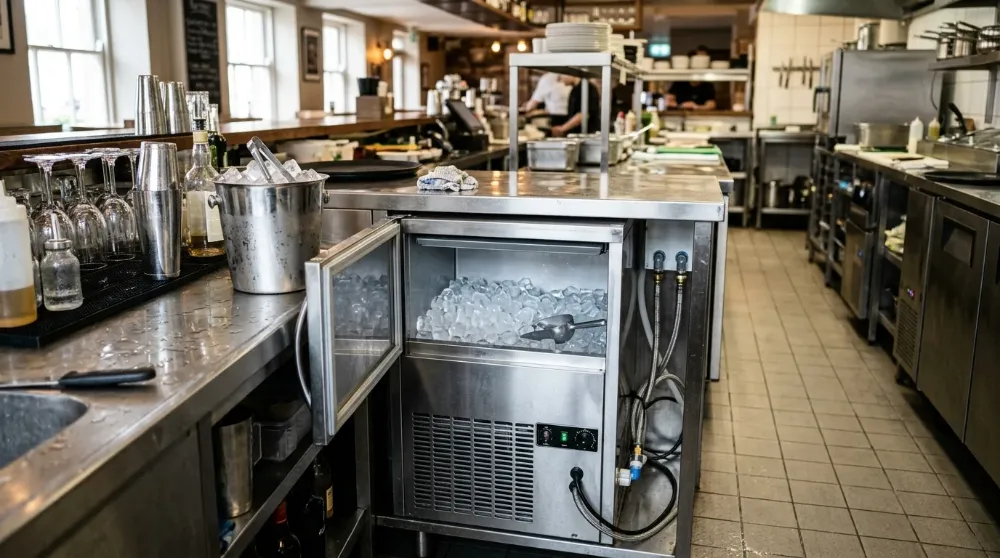
Undercounter and countertop ice makers
Self-contained units are simpler to fit and maintain, and they are often the practical choice for cafés, small pubs, function rooms, or any site where you need reliable ice without dedicating floor space to a separate bin. In Ireland, your ice still needs to be made from potable water, and FSAI guidance notes that potable water is legally required to be free from E. coli (FSAI Guidance Note 3, Revision 4). For a simple cross-check, Uisce Éireann also states the standard for E. coli in drinking water is 0 per 100 ml (Drinking water tests).
That water-quality angle matters even more when you start thinking about ice type, because some styles are more sensitive to scale, taste, and handling than others.
Which ice type suits which job?
Cube suits most mixed drinks because it is consistent and stacks well in a bin. Flake suits displays and chilling because it moulds around product and cools quickly. Nugget suits chewable soft drinks and some cocktails because it absorbs flavour and has a softer bite. Gourmet suits premium spirits and presentation-led serves because it is usually larger and melts more slowly when the glass is handled properly.
Once you know the ice style you want to serve, it becomes much easier to choose an output and storage size that holds up in real service.
Step-by-Step Buying Process
How do you select and purchase a commercial ice maker in Ireland? Start by sizing your daily ice demand, then match the machine type and production rate to how you actually serve drinks. Confirm the site can support the electrical load and water requirements, and that you have enough space and ventilation for reliable day-to-day running. Before you pay, double-check lead times, warranty terms, and whether professional installation or commissioning is required for supplier sign-off, compliance, or insurance, as that can affect both cost and downtime planning.
1. Calculate your ice needs
This step matters because an undersized unit runs flat out and still leaves you short at peak times. Aim to sanity-check your estimate against real service patterns, like weekends, functions, and takeaway drinks, because that is where an ice plan usually falls down.
2. Check power supply and water connection
This matters because your ice is classed as food, and under the European Union (Drinking Water) Regulations 2023 (S.I. No. 99/2023) you need wholesome water at the point of use, so plan filtration and a service valve. It is also worth confirming the socket type, breaker capacity, and isolation switch arrangement with a qualified electrician, because the right services in the right place make the installation far smoother.
3. Measure space and airflow
This matters because tight installs overheat condensers, cutting output and driving call-outs. A quick check of clearances, access for cleaning, and where hot air can escape helps you avoid buying a machine that looks fine on paper but struggles in a busy bar environment.
Questions to Ask Vendors
The right questions upfront usually prevent the expensive headaches later. In Ireland, the Food Safety Authority of Ireland (FSAI) treats ice as a food, so you want clear answers on hygiene, water filtration, and cleaning routines before you commit. The details vary by site because your water hardness, drainage, and available power can make one “great” model a poor fit, and that’s where a good supplier earns their keep.
Compatibility, support, and warranty questions
- What ice type (cube/flake/nugget) and kg/24h output is this rated for at realistic Irish ambient temperatures, and what’s the bin capacity?
- What power supply and plug type does it need on-site, and is commissioning required to keep the warranty valid?
- What water inlet size, filtration, and drainage (gravity drain or pump-out) does it need?
- Who handles breakdowns in Ireland, what are typical call-out timeframes, and what are spare parts lead times?
- What’s covered (parts and labour), for how long, and what voids cover (limescale, no filter changes, poor ventilation, incorrect cleaning chemicals)?
- Can you price the right accessories (filters, pumps, bins) and confirm fit with your chosen ice flake makers setup?
How this feeds into your final checks
Once you’ve got straight answers on output, services, and site requirements, you can sanity-check the numbers against your own demand and constraints, which is where buying decisions usually stand or fall.
Frequently Asked Questions
Capacity, installation, and hygiene are the three things that usually trip people up when buying a commercial ice maker in Ireland. The Food Safety Authority of Ireland (FSAI) is clear that you need food-grade controls, cleaning routines, and traceability like any other ingredient. What suits a quiet café won’t suit a weekend bar, and water quality plus ventilation can change real-world output, so it pays to sanity-check the numbers before you buy.
How do I size a commercial ice maker?
Sizing matters because running out of ice mid-service costs drink sales and staff time, so start from your busiest hour and work back to a realistic daily output, then choose the right cube or flake style from options like commercial ice flake makers. In practice, you also need to factor in storage bin capacity, recovery time, and Irish site conditions like warmer back-bar areas or tight airflow, because a machine’s headline “kg per 24 hours” figure is typically based on ideal test conditions rather than your premises.
How often should an ice machine be cleaned?
Cleaning frequency matters because biofilm builds quietly in damp Irish back-bar conditions, so follow the manufacturer schedule and treat descaling and sanitising as separate jobs, especially if you’re dealing with hard water. Keep a written cleaning log as part of your HACCP paperwork, and make sure staff know that scoop hygiene and clean, dedicated ice storage matter just as much as the machine itself, because that day-to-day handling is where problems often start.
Get the Right Ice Maker Spec for Your Service (and Keep It Compliant)
If you’re sizing an ice machine for a café, bar, hotel, or food production setup in Ireland, shop by the spec that actually matters in busy service: kg per 24 hours (realistic output), bin capacity, cube type, drainage, ventilation clearance, and water filtration options. Browse Caterboss’s range of commercial ice makers and, if you want a second opinion before you buy, contact the Caterboss team for practical trade advice and support with selecting a unit that suits your volume, space, and cleaning routine.
Summary and Next Steps
Experts generally agree that buying the right commercial ice maker comes down to matching daily output, bin capacity, and the type of ice to your actual service pattern, not your best-day hopes. HSE infection prevention and control guidance is a useful reminder that hygiene and cleaning access matter as much as spec sheets. Your best choice can vary a lot depending on Irish mains water quality, available drainage, and whether the unit will sit in a hot back bar or a cooler prep area, which is why planning the basics on site saves headaches later.
What to do next
After a shutdown or period of low use, follow the machine manufacturer’s cleaning, sanitising and recommissioning instructions before serving ice. Include the ice machine and dispenser in your documented cleaning schedule.
- Measure peak drinks per hour and convert to kg/day.
- Confirm water feed, filtration, and drainage route before ordering.
- Check clearance and airflow needs, especially in tight plant spaces where heat build-up can quietly wreck performance.
Once you have those numbers and site details in hand, comparing real-world models becomes much more straightforward.
Frequently Asked Questions About Commercial Ice Makers in Ireland
How do I size a commercial ice machine for my bar or café?
Start with your busiest trading pattern, not an average week. A practical approach is to estimate peak drinks per hour, multiply by the amount of ice per drink (your serve style matters), and convert that into a kg per day requirement, allowing a buffer for warm glassware, takeaway cups, and busy weather weekends. If you run cocktails, you typically need more consistent cube output than a coffee-led café that mainly fills iced lattes, so matching the ice type to the menu is just as important as total kg.
What is the difference between daily ice production and bin capacity?
Daily production is how much ice the machine can make in 24 hours under stated test conditions, while bin capacity is how much ice you can store on site at any one time. In simple terms, production keeps you topped up and the bin covers the rush. If your peak is short and sharp, a bigger bin can smooth things out, but if you are constantly busy across lunch and late evening, you will feel the limits of production rate very quickly.
Do I need a water filter for an ice machine in Ireland?
In many Irish premises, some form of filtration is a sensible investment for taste, scale control, and reliability, especially in hard water areas where limescale can shorten service intervals and reduce efficiency. A filter is not a one-size-fits-all box tick, though. You want the right type for your incoming water and usage, and you need a plan for changing cartridges on schedule so the filter does not become its own hygiene risk.
What drainage do commercial ice machines need?
Most plumbed-in commercial ice makers require a reliable drain connection for meltwater and purge cycles, and gravity drainage is often preferred where the layout allows it. Some installations use a pump, but that adds another component that needs cleaning and maintenance. It is worth checking the route, fall, and local access before you order, because drainage constraints can dictate where the unit can realistically sit in a bar or prep area.
Are there hygiene or cleaning rules I should follow for ice machines?
Yes. Ice is treated as food, so cleaning and safe handling should sit inside your HACCP-based food safety management system. Keep a documented cleaning schedule and follow the manufacturer’s instructions, including after shutdowns or periods of low use.
Where can I buy a commercial ice maker in Ireland with support and delivery?
Caterboss supplies trade grade ice makers for Irish hospitality, with options across different ice types and capacities, plus delivery nationwide. If you already know your numbers, you can shop by category and compare specs online at Ice Makers. If you are unsure on sizing, water, or siting, it is usually quickest to call the team with your peak demand estimate and your available space so you can narrow it down to a few models that suit your service.
Choose the Right Commercial Ice Maker for Your Service
If you have your peak drinks-per-hour, preferred ice type, and a quick note on water and drainage, you are ready to shortlist a machine that will keep up in real service. Browse Caterboss for trade grade options and specs at Commercial Ice Makers, or contact the Caterboss team for practical sizing help and finance options where available and subject to approval and partner terms.
How Caterboss Supports Your Ice Maker Needs
Pick a commercial ice maker that matches your service style, peak covers, and how quickly you burn through ice on busy weekends. Under FSAI guidance, you are responsible for food safety controls in your premises, so reliability and easy-clean design matter just as much as kilograms per day. In practice, a pub pushing cocktails needs a different set-up to a café filling display wells, and getting that match right saves stress in service.
Choosing confidently, with Irish trade support
If you want to compare outputs, bin sizes, and cube types quickly, the Ice Makers category lets you filter by the specs that actually affect service. Finance can also make sense for cashflow, and it is worth remembering that the FSAI notes food businesses must implement procedures based on HACCP, which puts a real spotlight on hygiene-friendly equipment, easy access for cleaning, and dependable performance when you are flat out. That practical balance of capacity, compliance, and day-to-day usability is what sharpens the key considerations before you buy.
Frequently Asked Questions About Commercial Ice Makers in Ireland
How do I size a commercial ice maker for my pub, café, or restaurant?
Size it around your busiest trading period, not your quiet midweek average. Look at your peak covers, drink mix (cocktails, soft drinks, table water, smoothies), and whether you need ice for food displays or seafood counters as well as the bar. In practical terms, a cocktail-led pub typically needs higher daily output and a bin that can hold enough ice to ride out rush periods, while a café might prioritise steady production and compact footprint over large storage.
What does “kg per day” mean on an ice machine spec sheet?
It is the manufacturer’s stated production capacity over 24 hours under test conditions, usually with specific ambient air temperature and incoming water temperature. In real Irish kitchens, production can drop if the room is warm, ventilation is poor, or the incoming water is warmer than the test rating. Treat the quoted figure as a benchmark for comparing models, then build in a buffer for busy service and seasonal peaks.
Are there food safety rules in Ireland I need to consider when buying an ice maker?
Yes. Ice is treated as food, so it needs to be produced, stored, and handled hygienically. The FSAI places responsibility on the food business to implement food safety management procedures based on HACCP, so choose equipment that is easy to clean, has sensible access panels, and supports routine sanitising. Keep clear cleaning records, train staff on safe handling, and avoid cross-contamination risks such as scoops stored directly in the ice bin.
What type of ice is best for Irish hospitality service?
It depends on what you serve. Full cube or large cube ice suits spirits and premium mixed drinks because it melts more slowly. Dice or half-cube is common for soft drinks and general bar use where fast chilling matters. Flake or nugget ice is often used for display wells and some food presentation. Matching ice type to service keeps drinks consistent and reduces waste from over-melting.
Do I need a drain and a water connection for a commercial ice maker?
Nearly always, yes. Most commercial ice makers require a mains water feed and a suitable drain for purge water and meltwater. The exact plumbing needs depend on whether the unit is undercounter, modular with a separate bin, or a self-contained model. It is worth confirming your available pipework and drainage before ordering, as small site constraints can dictate the most practical machine style.
Can I finance a commercial ice maker in Ireland through Caterboss?
Caterboss offers flexible finance options that can suit cashflow for new and established food businesses, subject to approval and partner terms. The best fit depends on your budget, trading pattern, and whether you are buying a single unit or fitting out a full bar or kitchen. If you are unsure, it is sensible to discuss the numbers and the equipment spec together so the repayments align with the capacity you actually need.
Get the Right Ice Maker for Busy Service in Ireland
If you are replacing a struggling unit or fitting out a new bar, start with a short list of machines that match your daily output, bin size, and ice type requirements, and keep HACCP-friendly cleaning in mind. Browse the Ice Makers category to compare trade-grade options, then contact Caterboss for practical Irish trade advice and finance options subject to approval and partner terms, so you can land on a set-up that stays reliable when the place is hopping.
Frequently Asked Questions About Commercial Ice Makers in Ireland
What factors should I consider when choosing a commercial ice maker in Ireland?
Focus on daily ice output, ice type, and storage, then sanity check the practicalities that catch Irish operators out:
- Peak service pattern: cocktails, soft drinks, iced coffee, seafood display, takeaway delivery.
- Available space and ventilation: air-cooled machines need clear airflow around the condenser, while water-cooled units need extra plumbing.
- Local services on site: confirm mains water pressure/quality, drainage, and whether you have single-phase or three-phase power available.
- Hygiene and compliance: look for easy-to-clean food-zone surfaces and a cleaning programme you can realistically keep up.
- Running costs and noise/heat: ice makers dump heat into the room, which matters in small kitchens and bars.
- Support in Ireland: warranty terms, parts availability, and service coverage can matter as much as the sticker price when you are busy.
How do I calculate how much ice my business will need per day?
Estimate ice per serve, multiply by expected serves at peak, and add a buffer for spill, staff drinks, and warm-glass recovery.
A practical method:
- List every use case (drinks, ice baths, prep, display, delivery).
- Assign grams per serve based on your glassware and recipes. For example, a spirit and mixer can use more ice than a short cocktail; a seafood display uses ice continuously.
- Multiply by peak-day volumes (busy weekend, events, good weather).
- Add a safety margin so you are not running out during the rush.
Check the maker’s spec carefully: published output is usually a best-case figure under test conditions, so real-world yield can be lower in warmer rooms or with warmer incoming water.
What types of commercial ice are available and what are they best used for?
Common options you will see on Irish supplier spec sheets:
- Full cube or large cube: slow-melting, good for spirits, premium serves, and high-end cocktails.
- Half cube: fast chilling with a bit more dilution, useful for mixed drinks and general bar service.
- Crushed ice: mojitos, caipirinhas, slush-style serves, rapid chilling and packing around bottles.
- Flake ice: seafood counters, deli displays, salad bars, and gentle chilling where you want full contact.
- Nugget or chewable ice (where available): soft texture, popular for soft drinks and some cocktail styles.
Your best choice is the ice that matches your menu and speed of service, not the one with the highest output number.
What is the difference between modular, undercounter, and countertop ice machines?
The difference is mainly capacity, footprint, and how the ice is stored.
- Modular (head-only) machines: the ice maker sits on top of a separate bin or dispenser. They suit higher-volume bars, hotels, and busy restaurants because you can scale output and storage separately.
- Undercounter machines: all-in-one units with built-in storage that fit under a standard counter. They are a strong fit for cafés, small bars, and satellite stations where space is tight.
- Countertop machines: compact units designed for lower volumes, pop-ups, staff areas, or small front-of-house counters where you cannot spare floor space.
Modular machines usually need more installation planning for clearance, drainage, and access for servicing.
How much storage capacity do I need in an ice bin or built‑in storage?
Aim for storage that covers your busiest stretch of service without forcing the machine to run constantly at peak.
Guidelines that work well in practice:
- If you have steady all-day demand (café, hotel breakfast, continuous soft drinks), storage can be closer to your hourly requirement.
- If you have sharp peaks (cocktail rush, functions, match days), you want a larger bin so you can build ice ahead of time.
- If you use ice for display (seafood or deli), storage usually needs to be higher because ice is being replenished and melts continuously.
Remember that a bigger bin is only useful if your machine can refill it quickly enough for your pattern of trade.
How does ambient temperature and water temperature in Ireland affect ice machine output?
Ice machine ratings are sensitive to conditions, so output typically drops when:
- the room is warmer (back bars, tight kitchens, utility rooms with poor airflow)
- the incoming water is warmer
- the condenser is dusty or blocked, which is common in busy prep areas
Even in Ireland, summer trade can coincide with warmer plant rooms and higher demand, which is exactly when an undersized unit struggles. If you are planning for seasonal peaks, choose a machine with headroom and keep ventilation clear so it can perform consistently.
What power supply and water connection do I need for a commercial ice maker?
Most smaller commercial ice makers in Ireland run on single-phase power, while higher-output modular heads often need three-phase.
On the electrical side, the Irish distribution system provides 400V and 230V AC supplies in the low-voltage network, as referenced in ESB Networks documentation Distribution Code Version 8.
On the plumbing side, you typically need:
- a cold mains feed to the machine, ideally with filtration where water quality calls for it
- a dedicated waste/drain connection that can handle continuous meltwater and purge cycles
Always check the unit’s installation manual for minimum water pressure, maximum inlet temperature, and drain type (gravity drain versus pumped drain).
What are the main installation requirements for a commercial ice machine?
Plan installation around reliability, hygiene, and service access:
- Level, solid base: prevents vibration and improves harvest consistency.
- Ventilation clearances: especially for air-cooled units behind the bar.
- Drainage you can trust: correct fall for gravity drains, or a suitable pumped drain setup if needed.
- Access for cleaning and servicing: you need space to pull filters, remove panels, and sanitise properly.
- Food-safe handling: install so scoops can be stored hygienically and staff can avoid hand contact with ice.
If the machine will sit in a tight back-bar cabinet, it is worth confirming airflow and drain routing before you commit to a model.
How do I clean and maintain a commercial ice maker?
Use the manufacturer’s cleaning and sanitising routine, and set a calendar that matches your trade level. A sensible approach is:
- Daily: wipe external surfaces, keep the scoop clean, empty and clean the scoop holder, check the bin lid closes properly.
- Weekly: wash and sanitise the bin interior, check for scale build-up, confirm the drain is flowing freely.
- Scheduled deep-clean: descale and sanitise the water system and food zone components as per the manual, plus condenser cleaning for air-cooled units.
Treat ice as food, and respond quickly to water-quality incidents. FSAI advice for cryptosporidium incidents includes the instruction to discard ice cubes in fridges, freezers and ice machines FSAI cryptosporidium leaflet.
Which ice maker is most suitable for bars, restaurants, and cafés?
Match the machine to your menu and footprint:
- Bars (cocktails and mixed drinks): a cube machine with enough storage for the rush, or a modular head and bin for high-volume venues.
- Restaurants: cubes for drinks plus additional capacity if you use ice in prep or for display; modular setups suit larger kitchens.
- Cafés: undercounter units are often the sweet spot for iced coffees and soft drinks without sacrificing prep space.
If you are weighing options, the most confident choice usually comes from combining your peak-day ice calculation with the realities of your bar or kitchen layout and the kind of guidance you will want to have to hand as you grow.
Keep Your Ice Setup Working All Year
Want practical buying and maintenance tips tailored to Irish hospitality, without the fluff? Subscribe to our newsletter and keep your setup efficient, compliant, and ready for the rush.
If you are already comparing models, browse our range of commercial ice cube machines to see real-world options and specifications side by side.