






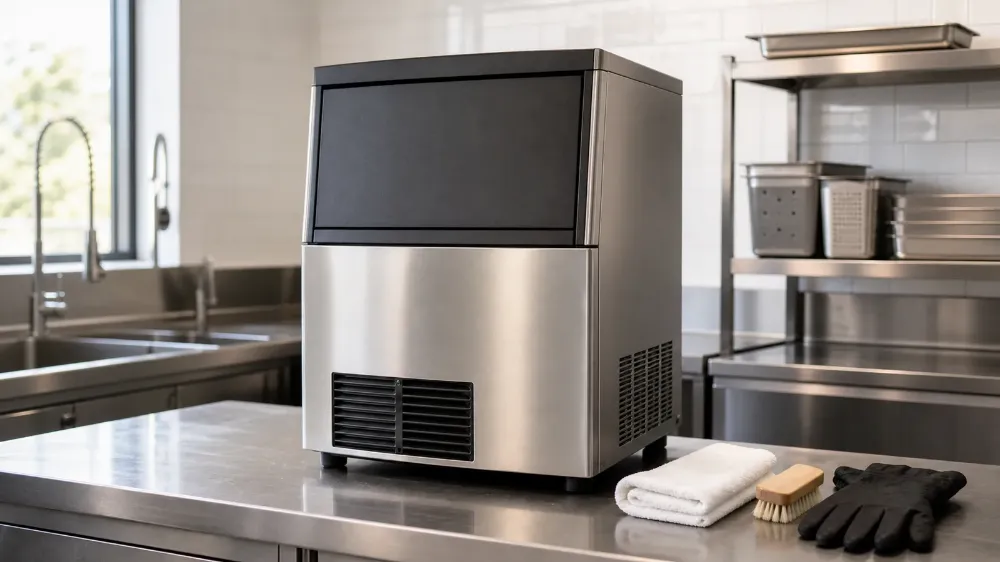
The safe approach is to separate routine exterior cleaning from the BIM40's powered Clean cycle. Isolate the water and electrical supply before any manual cleaning, remove all ice from the bin, and never splash water onto the machine. The automatic cycle needs the controls powered; it should be run only by a trained person who is authorised under the site's cleaning procedure. The manual places maintenance with qualified professional personnel, so stop and use a qualified professional whenever responsibility for an internal cleaning task is unclear.
A critical chemical limitation
The BIM40 manual tells the user to add cleaning and sanitising fluid, but it does not identify an approved product, dose, dilution, concentration, water temperature, compatibility rule or chemical contact time. This guide cannot fill in those omissions. Use only the exact food-contact cleaning and sanitising products already approved for the machine under your supplier and site procedure, following their labels. If that approved instruction is unavailable or conflicts with the machine manual, do not start the cycle; ask the supplier or a qualified professional.
Before manual cleaning
- Stop using the machine and remove the remaining ice from the storage bin so it cannot be contaminated.
- Cut off both the water source and the power supply before touching the machine for manual cleaning.
- Keep water away from electrical and service areas. Do not splash water directly onto the machine surface, and do not remove covers or reach into internal components.
- If the machine is malfunctioning, turn off the power and contact professional repair personnel rather than combining cleaning with fault-finding.
Exterior and storage-bin cleaning
Keep the area around the BIM40 clean and do not block its vents. Clean the outer enclosure with a mild detergent and then wipe it clean. A commercial stainless-steel cleaner or polish may be used if necessary, but the manual says not to use harsh sanitising sprays or cleansers. Dry spillages rather than leaving moisture on the stainless steel.
The storage bin should be cleaned regularly with mild detergent or sanitiser and then rinsed completely. Do not flush the area above the water pump or the evaporator directly. If the task requires access beyond the bin and other plainly accessible food-zone surfaces, stop and use the site's qualified professional.
Run the documented Clean cycle
Only continue when the operator is authorised, the approved chemical instructions are available and the machine has no fault or damage. The automatic cycle is a powered operating sequence, not a manual-cleaning step.
- Empty the ice bin in advance. The manual also requires the bin, ice sliding board, water distribution pipe, reservoir and water-supply pipe to be cleaned and sanitised, followed by complete rinsing; have a qualified professional handle any of those parts that are not clearly operator-accessible.
- Turn on the ice maker and hold the Clean button for 3 seconds. The display should show CLE when the clean process starts.
- Add the approved cleaning and sanitising fluid to the water reservoir using only its validated supplier or site directions. The manual also calls for cleaning and sanitising fluid to be applied to the evaporator; do not improvise the spray method, wet electrical areas or open service covers.
- Allow the 15-minute Clean cycle to finish. The machine then enters a 25-minute rinse cycle and displays RIN.
- When the cleaning cycle is complete, the display shows off. Before any manual wiping, cut off the water source and disconnect the electrical supply again. Following the approved chemical procedure, wipe the areas around the evaporator and ice storage bin with sanitising solution. Complete the authorised wipe and rinse work before restoring water and power and turning the ice maker back on.
- Discard the next 5 batches of ice because the manual warns that cleaner may remain.
Stop and escalate
Stop if power or water cannot be isolated for manual cleaning, the chemical or its directions are uncertain, or a required part is not clearly accessible. If the machine malfunctions, turn off the power and contact professional repair personnel. Any task that requires removing a guard or panel is professional maintenance outside this trained-operator guide.