
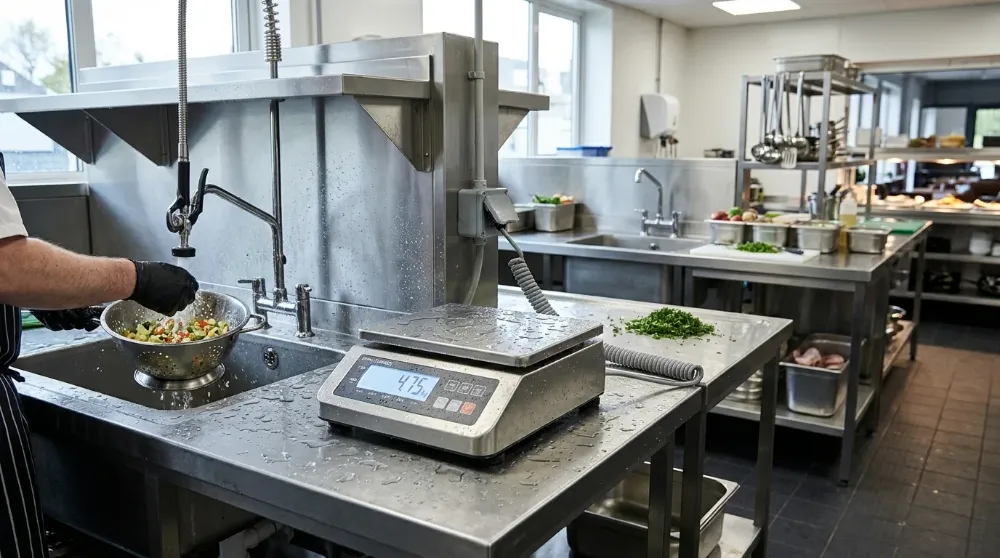
Commercial Weighing Scales in Ireland: IP Ratings and Waterproof Features
Choosing the right commercial weighing scale matters because accuracy, hygiene, and durability directly affect compliance and day to day efficiency in Irish food and manufacturing settings.
You match the scale type to how you work, whether that is portion control on a prep bench, weighing crates on a platform, or checking weights on a packing line where speed and repeatability matter. In wet rooms and washdown areas, you also need a clear view of waterproof protection, since an IP rating such as IP65, IP66, or IP68 signals very different tolerance for splashing, heavy spray, and exposure to moisture during cleaning.
You weigh up practical tradeoffs like stainless steel build for corrosion resistance, features like checkweighing and parts counting for tighter process control, and the realities of cleaning routines that may include hose down or pressure washing. You keep legal use in mind too, including when a scale needs to be suitable for trade use for selling by weight, plus the availability of calibration, servicing, and repairs from suppliers operating in Ireland. If you are integrating weighing into labelling, dispatch, or software workflows, connectivity and system compatibility become part of the decision, not an optional extra.
With those priorities clear, you can narrow the options by starting with the scale formats used across Irish food and manufacturing operations.
Commercial weighing scales are trade-grade instruments you use to measure ingredients, portions, or packed goods accurately and consistently in busy Irish food and manufacturing settings. Choose based on capacity, platform size, and how often the scale gets wet, moved, or cleaned down. One detail that catches people out is whether the weighing is legal for trade at the point of sale, because that can determine whether you are allowed to use a particular model when you are charging customers by weight, and it is overseen in Ireland through NSAI Legal Metrology under the rules for measuring instruments used for trade. NSAI Legal Metrology
Bench scales (portioning and prep)
Bench scales suit portion control, batching, and check-weighing where speed matters more than heavy capacity. They are a solid fit for pass-through prep areas, bakeries, delis, and production kitchens where you want fast, repeatable results without taking up much counter space, and they tend to be the type you notice most when consistency starts affecting yield and margins.
Platform and specialised scales (production and retail)
Platform scales handle larger crates and sacks, while retail scales are commonly used where you are pricing by weight and printing labels or receipts. If the scale is used for trade at the point of sale, it needs to be suitable for that specific trade use and handled through the appropriate legal metrology route in Ireland (for example, the correct instrument type and any required verification), which is what protects both you and the customer in a sale-by-weight scenario. NSAI Legal Metrology enforcement information
Importance of Waterproof and Washdown Weighing Scales
Choose waterproof and washdown weighing scales for Irish food production because water, brine, steam, and detergents turn tiny gaps into hygiene risks and costly downtime. In real prep rooms, a failed keypad or a corroded load cell usually shows up mid-shift, right when you are portioning or batching. The stricter your cleaning regime, the more you need a scale that is built to be washed down properly, not just described as “splash-proof” on a spec sheet, and that is where IP ratings start to matter.
IP65 vs IP66 vs IP68 in practice
IP ratings come from the IEC 60529 standard for Ingress Protection, and the differences matter in a wet Irish production environment. IP65 is commonly associated with protection against water jets, IP66 with more powerful water jets, and IP68 with immersion beyond the IP67 test, under conditions specified by the manufacturer. In practice, always check what the manufacturer means by IP68 because “immersion” is not one universal depth or duration, and your real cleaning routine is what determines whether the rating holds up day to day.
HACCP and pressure-wash reality checks
HACCP relies on equipment you can clean effectively. If pressure washing or strong jets are part of your routine, select a scale that is specifically designed for that cleaning method and follow the manufacturer’s cleaning instructions. Even with a suitable IP rating, avoid directing high-pressure spray at seals, keypads, connectors and cable entries at close range, because technique and wear over time can still lead to water ingress. For wider context on Irish food hygiene obligations and HACCP-based procedures, see the FSAI overview of the hygiene of foodstuffs.
Match the scale’s IP rating to where it will sit, how it will be cleaned, and what “wet” actually means in your premises. Start by mapping splash zones and washdown routines, then choose the lowest IP rating that safely covers that reality. Confirm whether the indicator or display, load cell, and connectors share the same protection level, not just the headline number on the spec sheet. Give the fine print a proper read, because “waterproof” can still fail under hot, high-pressure cleaning, especially in busy Irish food sites where washdowns are frequent and fast.
1. Define your wet-risk and cleaning method
Start by deciding if you’re dealing with splashes and wipe-downs, hose-downs, or full washdown.
In simple terms, “wet risk” is a mix of how much water the scale sees, how often it happens, and how aggressive the cleaning is (spray pattern, pressure, temperature, and chemicals). That combination is what tends to expose weak points like keypads, seams, cable glands, charging ports, and load cell entry points, which is why the cleaning method matters as much as the location.
2. Pick the IP level that fits (not the biggest number)
IP65 suits splashes; IP66 suits strong jets; IP67 covers temporary immersion under standard test conditions; IP68 covers immersion beyond IP67 under manufacturer-specified conditions; IP69K is for hot, high-pressure washdown (where that rating is stated for the equipment).
IP ratings are defined under the IEC 60529 standard, with the two digits describing protection against solids and water. The “6” you see in IP65 or IP66 means dust-tight, while the second digit is the important part for water exposure. It’s worth keeping in mind that IP68 and IP69K are not “better versions of the same test” as IP65, they are different tests for different scenarios, so you want the rating that matches how you actually clean.
Choosing the right number is only half the job, because real kitchens and food production areas have awkward spray angles, quick clean downs during service, and staff doing the best job they can at speed, which brings you to the common failure points.
3. Avoid common Irish food-site pitfalls
Don’t assume the whole unit matches the headline IP, don’t jet-wash seals meant for wipe-down, and don’t ignore cable glands and charging ports.
What we see catch Irish operators out is buying a “washdown” scale where only the weighing platform is protected, while the indicator head, junction box, or power connection is rated lower. Another common one is using a pressure washer or strong jet on seals designed for wipe-down cleaning, which can force water past gaskets even when the IP number looks reassuring on paper. Cable glands, USB ports, charging cradles, printer connections, and any add-on accessories are frequent weak links, so you want to check the protection level for the complete setup as it will be used on your floor, not just the core scale body, because that’s what determines whether you get reliable day-to-day performance.
Frequently Asked Questions About IP Ratings for Weighing Scales
What does an IP rating actually tell you on a commercial weighing scale?
An IP rating tells you how well the scale enclosure resists the ingress of solids and water, based on tests defined under IEC 60529. The first digit relates to protection against dust and solid objects, and the second digit relates to water exposure. It does not automatically cover every component in a weighing setup, so you need to confirm the rating for the indicator or display, load cell, junction box, and connectors as well as the platform.
Is “waterproof” the same as IP-rated?
No. “Waterproof” is often used loosely in product descriptions, while an IP rating is a specific, test-based classification. Even with an IP rating, the protection only applies under the conditions of the relevant test, so hot water, high pressure, aggressive detergents, damaged seals, or poor cable entries can still cause failures in real washdown environments.
Which IP rating do I need for a typical Irish commercial kitchen?
It depends on your cleaning routine. For many dry-to-damp prep areas where you mainly wipe down and deal with occasional splashes, IP65 is often a sensible baseline. If the scale is likely to be hit with strong water jets during cleaning, IP66 is more appropriate. If the unit may be accidentally submerged, you are into IP67 for temporary immersion under standard test conditions, or IP68 where immersion beyond IP67 is a realistic risk under the manufacturer’s specified conditions, although many kitchen sites do not actually need immersion protection if cleaning and storage are managed properly.
Is IP69K always the best option for food sites?
Not always. IP69K is designed for hot, high-pressure washdown, which suits certain high-hygiene environments, but you still need to check that the whole system is rated appropriately, including connectors and any external peripherals. IP69K can also be overkill if you only wipe down or lightly hose an area, and choosing a higher rating than you need can narrow your options and increase cost without improving reliability for your actual cleaning method.
Can I pressure-wash an IP65 or IP67 scale?
You should not assume you can. IP65 and IP67 are different tests (jets versus immersion), and neither rating on its own guarantees suitability for hot or high-pressure washdown in real conditions. If pressure washing is part of your routine, choose equipment specifically designed for that use case and follow the manufacturer’s cleaning instructions to avoid forcing water past seals.
Why do scales fail in wet areas even when the spec says IP66 or IP67?
In practice, failures usually happen at the weak points rather than through the main enclosure. Common culprits include cable glands that were not tightened correctly, connectors or ports left exposed, cracked keypads, worn gaskets, water tracking down cables into the housing, or mixing rated and non-rated components in one setup. Cleaning chemicals and heat can also age seals faster, which matters in busy sites where the equipment is cleaned repeatedly.
Choose a Weighing Scale That Matches Your Washdown Reality
If you are fitting out a commercial kitchen, deli, butchery, bakery, food production unit, or back-of-house prep area anywhere in Ireland, get the IP rating right before you buy. Share where the scale will sit, how you clean the area, and whether you are wiping down, hosing down, or doing full washdown, and Caterboss can help you choose a trade-grade option that stands up to daily use. If you also need to protect cash flow, ask about flexible finance options that are subject to approval and partner terms, so you can get the right kit in place without guessing on spec.
Key Features and Benefits of Stainless Steel Weighing Scales
Stainless steel weighing scales are often the safest bet in wet Irish prep areas because they clean down quickly and stand up well to constant splashback. In day-to-day HACCP routines, the real win is a smooth, non-porous platform that does not trap fish slime, meat juices, or produce grit. The nuance is that “stainless” alone is not enough because sealing quality, cable glands, and load cell protection are what decide whether a scale survives regular washdown and busy service.
Hygiene and corrosion resistance in wet prep
Hygiene matters because the quicker you can strip, rinse, sanitise, and reset, the less time food sits in the danger zone and the less cross-contamination risk you carry between raw and ready-to-eat tasks. This lines up with the legal expectation on food businesses in Ireland to operate procedures based on HACCP principles under Regulation (EC) No 852/2004, as set out in the FSAI overview of the hygiene of foodstuffs.
Corrosion resistance matters just as much in real kitchens because Irish prep rooms can be damp, and you are often dealing with salt, acids, and strong cleaning chemicals, so the finish, weld quality, and how well moisture is kept out of the internals is what prevents premature failures that show up right in the middle of a prep rush.
IP68 extras that actually earn their keep
- Parts counting: handy for portion control on chopped veg or seafood packs.
- Check weighing: speeds up consistent packs for counter sales and prep labels.
- Dual displays: useful when a second person is checking weights across the bench.
IP ratings are defined under IEC 60529, and IP68 indicates full dust protection and immersion protection beyond IP67 under conditions specified by the manufacturer, so it is worth checking what the brand actually states for washdown and cleaning routines rather than assuming every IP68 unit behaves the same in a hard-working food environment.
Trade Approval and Supplier Support in Ireland
If you’re selling by weight, you need a scale that’s suitable for trade use, not just “accurate enough”. In Ireland, that means the instrument has to meet the applicable legal metrology requirements for the way you are using it, and may need to be verified through the correct route. A key practical point is that waterproofing (IP rating) and trade suitability are separate requirements, so you often need both for a busy, washdown-heavy food environment.
Trade approval: what to look for
Trade approval matters because it protects you during inspections and in customer disputes. NSAI outlines how the system works for authorised verification of non-automatic weighing instruments used for trade in Ireland, including who can verify equipment and what “verified for use for trade” means in practice for the relevant instrument and application. Once you know the compliance side is covered, the day-to-day reality comes down to how easily you can keep the scale working accurately in service.
Calibration, servicing, and repairs in Ireland
Ongoing support matters because seals, load cells, and displays can fail under washdown, knocks, and constant daily use. Having an Ireland-based supplier and support route can reduce downtime, especially when you need parts or a quick turnaround. Browsing commercial weighing scales can help you compare models that are commonly used and supported here, and it naturally brings you onto the practical buying questions like capacity, readability, and the right platform size for your portions and containers.
Role of Weighing Scales in Integrated Systems
When you connect a trade weighing scale into your wider workflow, weights flow straight into intake records, pack weights, label data, and dispatch paperwork, cutting hand-entry errors immediately. In practice, Irish food producers and busy commercial kitchens rely on this because one mistyped digit can ripple into wrong price-per-kg labels, incorrect batch documentation, and avoidable customer credits. The knock-on effect usually shows up fastest at packing and labelling, then later in dispatch when weights do not reconcile with orders. Over time, clean scale data makes stock, yield, and waste reporting far more believable, which helps when you are tightening margins and trying to keep compliance paperwork tidy.
From intake to dispatch (software, labels, carriers)
At goods-in, the scale weight can populate your system as a receipted quantity; at packing, it can trigger price calculation and print labels; and at dispatch, it can feed parcel weights into courier or postal tools so your shipping charge matches what is actually leaving the building. That kind of end-to-end accuracy only holds up when the scale itself is suited to the job and the trade requirements you operate under.
How Consultants Help with Equipment Selection
The “right” commercial weighing scale is the one that matches your workflow, your cleaning routine, and how you sell by weight in busy service. In Ireland, the NSAI Legal Metrology team is a practical reference point because it oversees verification routes for non-automatic weighing instruments used for trade. Two scales with the same capacity can behave very differently once you add washdown, condensation, and the day-to-day knocks that happen in real kitchens and production rooms, so it pays to choose with your actual conditions in mind.
Buying advice that prevents expensive rework later
Good consultants, often people who have run kitchens or production lines themselves, start with what cannot be argued with: if you are weighing for sale, you need the correct legal metrology route for your use case. NSAI sets out how to approach this, including guidance on finding an authorised verifier for non-automatic weighing instruments. That quick check upfront helps you choose a suitable IP-rated body and platform that stands up to washdown without compromising compliance, which also makes it easier to standardise your process across prep benches, packing stations, and pass-through areas.
Frequently Asked Questions About Choosing Commercial Weighing Scales in Ireland
Do I need a trade-approved scale in Ireland if I am selling food by weight?
Yes. If you charge customers based on weight, the scale used for that transaction needs to be suitable for use for trade, and you should confirm what verification or other legal metrology steps apply to your instrument and use case in Ireland. The NSAI Legal Metrology function oversees the system around verification for non-automatic weighing instruments used for trade, and it is worth confirming the correct approach before you buy so you do not end up replacing a perfectly good scale that is not suitable for trade use.
What is a “non-automatic weighing instrument” in plain English?
It is the typical commercial scale where an operator places an item on the platform and reads the weight, rather than a fully automatic in-line system. Bench scales, platform scales, and many portion-control scales used in kitchens fall into this category. If you use that scale to determine the price a customer pays, the trade-use and verification requirements matter.
Who can verify a weighing scale for trade use in Ireland?
Verification is carried out by an authorised verifier. NSAI provides practical direction on how to source one via its page on finding an authorised verifier for non-automatic weighing instruments. Checking verifier availability for your scale type and location can influence what model you choose and how quickly you can get operational.
What should I prioritise for scales used in wet or washdown areas?
Look for a scale designed for your cleaning reality, not just the weight capacity. In food production and back-of-house settings, an appropriate IP rating, corrosion-resistant materials, sealed keypads, and a platform that is easy to remove and clean can make the difference between reliable daily use and constant drift, faults, or water ingress. In practical terms, the scale has to survive regular sanitation, humidity, and cold-room condensation without becoming a weak link in your HACCP routine.
Can two scales with the same capacity perform differently in a commercial kitchen?
They can, and it is common. Build quality, load cell protection, platform stability, tolerance for vibration, and resistance to moisture all affect how a scale behaves over time. In a real Irish kitchen, steam, splashes, and temperature swings are normal, so durability and sealing often matter as much as headline specifications.
How do I choose between a bench scale and a platform scale?
A bench scale suits portioning, smaller packs, and pass work where space is tight. A platform scale suits heavier crates, bulk ingredients, and floor-level weighing in stores or production. The right choice comes down to how you move product, the weights you handle, your available space, and whether you need portability, ramps, or integration with label printing and stock processes.
Get the Right Trade-Ready Scale Setup for Your Kitchen
If you are weighing for sale in Ireland, start by confirming the correct legal metrology route for your use case and choosing a washdown-friendly scale that matches your workflow. Caterboss can help you sense-check the practical details that usually get missed, including platform size, durability for busy service, and what makes day-to-day cleaning easier, then point you towards the right equipment options for your setup. Browse commercial kitchen essentials on Caterboss and reach out to the team for trade-first buying advice and finance options where suitable at Caterboss.
Frequently Asked Questions
Do commercial weighing scales need a waterproof IP rating in Ireland?
It depends on where the scale lives in your operation and how it gets cleaned. There is no single Irish regulation that says every commercial scale must be waterproof, but your HACCP procedures and day-to-day hygiene routine effectively set the requirement. If the scale is regularly exposed to spray, splashes, or washdown cleaning, choosing a properly tested IP-rated unit helps prevent failures and reduces the risk of drifting or inconsistent readings during busy service, which is where problems usually show up.
When is the answer “no”?
If the scale is used in a dry storeroom, office, or back counter where it is only wiped with a damp cloth, full waterproofing is often unnecessary. In those environments, basic spill resistance and sensible handling can be enough, as long as the scale is kept away from sinks, steam, and heavy condensation, which tend to shorten the life of non-sealed electronics.
Why do IP ratings matter?
An IP rating is a standardised measure of how well an enclosure resists dust and water ingress, defined under IEC 60529. In simple terms, it gives you a comparable, test-based spec rather than a vague “water-resistant” claim, so you can match the scale to how your kitchen actually operates. For a reference point used in Irish technical documentation that cites governing standards including IEC 60529, see EirGrid’s note on the Degrees of protection provided by enclosures (IP Code), which reflects the same international standard used across many commercial equipment specifications.
A practical Irish trade-off
Irish kitchens tend to deal with damp conditions, frequent wipe-downs, and strong cleaning chemicals, so water will find the weak points quickly, especially around keypads, load cells, and cable entry points. If your cleaning is aggressive, it usually pays to buy for the worst day rather than the best one, because downtime during service costs more than the upgrade. That same “fit it for the environment” logic applies across commercial kit, where a tougher spec often saves you hassle long after the purchase decision is made.
Choose the right commercial scale for your kitchen environment
If you are weighing in a prep area, bakery, butcher counter, or any space that sees regular wiping and heavy cleaning, it is worth matching the scale spec to your real workflow rather than guessing. Browse Caterboss for trade-grade weighing scales and commercial kitchen equipment, and if you want a quick steer on IP ratings, capacity, and the best fit for your cleaning routine, contact the Caterboss team for practical advice and support before you buy.
Frequently Asked Questions About Commercial Weighing Scales in Ireland
What types of commercial/industrial weighing scales are available for food and manufacturing businesses in Ireland?
Irish food and manufacturing sites typically choose from a few proven scale formats, depending on workflow and cleaning routines:
- Bench and compact waterproof scales for portioning, prep, QC and small goods handling.
- Platform and floor scales for crates, tubs, sacks and palletised product in stores and dispatch.
- Price computing and labelling scales for retail counters and deli operations where weight drives price and labels.
- Counting scales for packaging lines, parts handling and inventory control.
- Printer and connectivity-ready systems where weights feed into labelling, traceability or stock software.
If you sell by weight to the public, make sure the model is suitable for trade use and verified through Ireland’s legal metrology system overseen by NSAI Legal Metrology.
Which waterproof or washdown weighing scales are suitable for food production environments?
For wet prep, seafood, meat rooms and any area cleaned with foaming chemicals or frequent rinsing, look for stainless steel construction with a sealed indicator and an IP rating that matches how aggressive your washdown is.
A practical benchmark to start comparing models in very wet zones is an IP68 bench scale, such as the Jadever JWP Waterproof Scales, which is listed as IP68. However, IP68 alone does not automatically mean it is suitable for every washdown method (for example, hot water jets, pressure washing, or specific detergents), so it is still important to confirm suitability for your exact cleaning routine in the manufacturer guidance.
If you are weighing larger tubs or crates, pair a washdown-safe indicator with a platform that suits your footprint and load handling, and keep cable entries and connectors protected so hygiene routines do not become a failure point.
What IP rating do I need for weighing scales used in wet or washdown areas?
Match the IP rating to the way water hits the scale in real life:
- IP65 suits splash and wipe-down, or light hose-down where you are avoiding direct jets at seals.
- IP66 is a better fit where stronger water jets are used during cleaning.
- IP67 covers temporary immersion under standard test conditions, such as accidental submersion.
- IP68 is typically chosen where immersion beyond IP67 may occur, within the manufacturer’s stated conditions.
In Ireland, IP ratings are commonly referenced against IEC/EN 60529 as the basis for enclosure protection levels.
Do Irish suppliers provide calibration, servicing and repair for industrial weighing scales?
Many Irish suppliers and service partners do provide on-site calibration, preventive servicing and repair, which matters because downtime in production or dispatch is usually more expensive than the scale itself.
For trade use instruments, you also need the correct legal metrology support chain, since verification is part of keeping trade transactions fair, and NSAI maintains routes to authorised verifiers through its Legal Metrology service.
If you are buying new scales for trade, the regulatory framework in Ireland is set out in the European Union (Non-Automatic Weighing Instruments) Regulations 2018, S.I. No. 47/2018.
What capacities and graduations are available for bench and platform scales?
Bench and platform scales come in a wide spread of capacities and resolutions, and the right combination depends on whether you prioritise portion accuracy, speed, or heavy goods handling.
For example, a compact waterproof bench scale may offer fine graduations at lower capacity, such as the Jadever JWP Waterproof Scales listing for 15kg x 1g, while counter retail scales often use dual-range or stepped divisions, such as the Dibal M525 Labelling Scales listing for 6/15kg x 2/5g.
Platform and floor models extend into higher capacities for crates and pallets, but the same rule holds: choose the smallest graduation you genuinely need, because it affects stability, verification options and day-to-day usability when the pace picks up and hygiene pressure is on.
Get Practical Scale Buying Advice for Irish Food Operations
If you are weighing in wet areas, the right IP rating and build quality can save you repeat breakdowns and costly mis-weighs, especially when cleaning routines get more intense.
Subscribe to our newsletter for straight-talking guidance from people who understand Irish kitchens and production floors, and browse our commercial weighing scales when you are ready to compare real-world options.