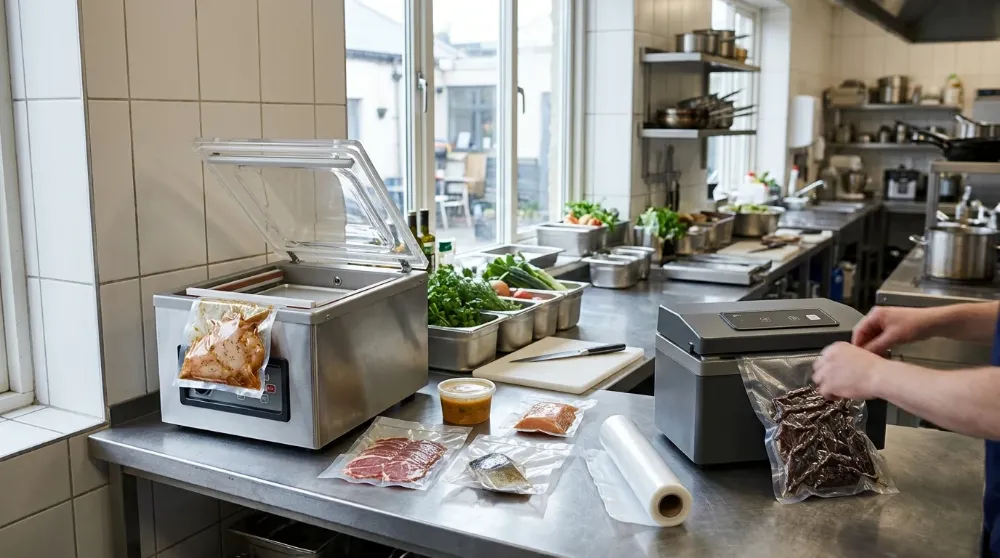
Choosing between a chamber and an external commercial vacuum packing machine matters because it affects food quality, shelf life, workflow, and compliance in Irish food businesses.
You weigh how each type handles the products you pack every day, from dry portions of meat and cheese to liquid-heavy items like soups, sauces, and marinades. You compare sealing reliability, speed at service, bag and consumable costs, footprint on the prep bench, and how consistently you can achieve a tight seal when staff are working under pressure. You also factor in practical constraints such as power availability, cleaning routines, maintenance downtime, and the risk of seal failure that can lead to waste or food safety issues.
With those trade-offs clear, you can connect the technology back to how vacuum packing developed and why different machine designs suit different Irish hospitality and food production setups.
Chamber vs External Commercial Vacuum Packing Machine
Choose between a chamber and an external commercial vacuum packing machine based on what you pack, how often you pack it, and how tightly you need to control shelf life in an Irish food business. Both remove air and seal bags, but they behave very differently with liquids, soft foods, and long production runs. The choice also feeds into food safety decisions because reduced oxygen can increase the need to control hazards such as Clostridium botulinum in some vacuum-packed or modified-atmosphere foods, which is part of the wider shelf-life validation picture in Irish guidance. Getting the right format helps you avoid seal failures in busy service, keep output steady during prep, and manage chilled storage with more confidence under HACCP.
Why chamber machines suit liquids and high-volume prep
A chamber unit pulls vacuum on the whole chamber, so soups, marinades, and wet proteins seal cleanly without “boil-over”. In practical terms, it is the steadier option when you are batching portions, sealing sauces for cook-chill, or packing proteins in volume because the vacuum level is controlled inside the chamber rather than pulling air directly out of an open bag mouth. That focus on controlling conditions aligns with the risk-based approach in Irish shelf-life validation guidance for vacuum-packed foods, including the need to assess safety factors when oxygen is reduced, as outlined in FSAI Guidance Note 18 (Revision 5): Validation of Product Shelf-life. Once you know a chamber machine can handle wet product without fighting you, it becomes easier to judge whether the added footprint and spend makes sense for your day-to-day workflow.
Why external machines work for lighter, smaller runs
An external (edge) sealer is often a better fit when you are portioning dry items, sealing small batches, or working in tighter spaces where a countertop unit is the realistic option. The trade-off is that bag choice and product moisture matter more, because the machine pulls air out through the bag opening and can struggle if liquids reach the seal area. In busy kitchens, what we see work is using external units for things like dry cured items, cheese blocks, portioned dry ingredients, or short-run prep where you want speed and simplicity, while accepting you may need to be more disciplined about keeping the seal zone clean and dry. Looking at specifications alongside the range of vacuum packing machines helps you match sealing style, cycle time, and bag type to the pace and reality of your kitchen, especially when you are balancing performance with counter space and budget.
Frequently Asked Questions About Chamber vs External Commercial Vacuum Packing Machines
Which vacuum sealer is better for liquids like soups and marinades?
A chamber vacuum packing machine is usually the better choice for liquids because the vacuum is created inside the chamber around the bag, which reduces the chance of liquid being pulled into the seal area. That makes it far easier to get clean, repeatable seals on soups, sauces, marinades, and wet proteins during batch prep in Irish kitchens and food production settings.
Can an external vacuum sealer handle wet foods at all?
It can, but it is more sensitive. With an external (edge) sealer, liquid can creep towards the seal and cause weak seals or failed bags, so you often need to chill the product and keep the bag mouth dry. For many businesses, that extra handling is acceptable for occasional wet items, but it is rarely as smooth as a chamber machine for routine liquid packing.
Does vacuum packing automatically make food safe for longer shelf life?
No. Vacuum packing removes air but does not sterilise food or, by itself, establish a safe shelf-life. Irish operators still need to manage time and temperature controls and validate shelf life for relevant foods within their HACCP-based system, as discussed in FSAI Guidance Note 18 (Revision 5): Validation of Product Shelf-life.
What type of bags do chamber and external vacuum sealers use?
Chamber machines typically use smooth vacuum pouches, which are usually more cost-effective per bag and come in a wide range of sizes. External machines usually require embossed or textured bags (or compatible rolls) to allow air to be pulled out through the bag channels. Bag availability and ongoing bag cost can be a deciding factor when you are vacuum packing daily.
Which option suits a small café, deli, or takeaway in Ireland?
An external vacuum sealer can be a solid fit when you are doing lighter daily prep, portioning dry foods, or sealing occasional batches without needing a large footprint. A chamber machine often suits delis and cafés once vacuum packing becomes part of regular production, especially if you are sealing wet items, doing cook-chill prep, or need consistent seals during busy periods where rework wastes time and product.
Do I need to factor vacuum packing into HACCP and labelling?
Yes. Vacuum packing is not just a packaging choice, it is a food safety control point in many operations. You should document the process in your HACCP plan, manage time and temperature controls, and ensure labelling supports safe shelf-life management, particularly for chilled foods. Where you are setting or extending shelf life, Irish guidance such as FSAI Guidance Note 18 is a key reference point.
Choose the Right Commercial Vacuum Packing Machine for Your Kitchen
If you are vacuum packing every day, the quickest win is matching the machine type to what you actually seal, especially liquids versus dry portions and short runs versus batch prep. Browse Caterboss’s range of trade-grade vacuum packing machines and pick out a few options that fit your counter space, output, and bag format. If you want a second opinion before you buy, contact the Caterboss team for practical, trade-first advice that suits Irish kitchens and food producers, and ask what finance options may be available where relevant (subject to approval and the provider’s terms, and always check the written finance agreement and product warranty).
Choose vacuum packing as a practical way to tighten up food hygiene, reduce waste, and keep busy Irish prep schedules under control, but match the machine to what you actually seal. Factor in wet products, portion sizes, and daily throughput so you get consistent seals without slowing service. Lean on the right category of machine for the job, with chamber machines suiting liquids and higher-volume production, and external (suction) machines making sense for lighter-duty packaging and tighter budgets. Keep food safety front of mind because vacuum packing creates low-oxygen conditions where certain bacteria can grow if time and temperature controls slip, a point highlighted in Food Safety Authority of Ireland guidance on sous vide practices (FSAI: Sous Vide and Food Safety). Once you anchor the decision in what you pack, how fast you pack it, and how you control shelf-life, the rest becomes a straightforward equipment choice you can act on today.
Background and Development
Experts generally agree that vacuum packing evolved from simple air-removal sealing into a core shelf-life and hygiene tool for professional food businesses. In Ireland, food business operators (FBOs) leaned on it as menus widened and prep moved earlier in the day, but the “right” machine still depends on wet products, portion sizes, and throughput. That’s what drove two families of kit: chamber machines for liquids and speed, and external machines for lower-cost, lighter-duty sealing. That choice matters even more once you start tying vacuum packing into HACCP checks, shelf-life validation, and day-to-day temperature control in a busy kitchen.
Why Irish operators split between chamber and external
In Irish retail and production, vacuum packing is routine. In simple terms, the machine decision tends to follow the product.
- Chamber vacuum packers suit wet foods, marinades, soups, sauces, and higher-volume production, because the bag sits inside the chamber and pressure equalises before sealing.
- External (suction) vacuum packers suit drier items and lower throughput, where you can live with slightly slower cycles and you want a smaller, lower-cost footprint.
If you’re also dealing with powders or crumbs and you find housekeeping becoming a bottleneck, the same general lesson applies in kitchens: match the tool to the material you’re handling, and your results and maintenance workload improve quickly.
Defining Chamber and External Vacuum Packing Machines
A commercial vacuum packing machine removes air from a bag to slow oxidation, reduce freezer burn, and tighten portion control in busy Irish food operations. The two main types are chamber and external (suction) machines, and they differ in how they create vacuum and what bags they can seal. The nuance is that liquids, marinades, and soft foods behave very differently depending on the vacuum method, so choosing the right format saves time, reduces waste, and keeps your process more predictable in service.
Chamber vacuum packing machines
A chamber machine places the full bag inside a sealed chamber, pulls vacuum from the whole chamber, then seals cleanly, which is why it’s the steady choice for liquids and high-volume prep. Day to day, it also tends to be more consistent across different bag loads and shapes, which matters when multiple staff are packing during a busy shift. Because these machines are built for commercial kitchens, routine cleaning and sensible housekeeping around the unit supports reliability and hygiene, especially around sealing bars and vacuum pump servicing.
External (suction) vacuum packing machines
An external machine grips the open end of the bag, sucks air out from the mouth, and then seals, which makes it compact and usually cheaper, but fussier with wet products and bag fit. In practical terms, you often get great results on dry portions, cheese, and cooked meats, but you need more care with liquids, fine powders, and strong marinades that can creep into the seal area. Food safety still sits above the equipment choice, and the Food Safety Authority of Ireland (FSAI) notes that vacuum packing and other reduced-oxygen methods require robust controls when validating shelf life, including managing hazards such as non-proteolytic Clostridium botulinum in chilled foods, as outlined in FSAI Guidance Note No. 18 (Revision 5): Validation of Product Shelf-life. That’s why it pays to think about your menu, your cold chain, and who is doing the packing as much as the machine itself.
Direct Side-by-Side Comparison
Choosing between a chamber vs external commercial vacuum packing machine comes down to speed, bag cost, and what you’re sealing day-to-day. The main difference is that chamber machines evacuate air from the whole chamber, while external machines evacuate air only from the bag mouth. Chamber units usually give stronger, more consistent seals on liquids and wet marinades than external clamp-style machines. External machines are typically smaller and cheaper to start with, but can be slower for high-volume packing. Vacuum packing can support quality and organisation, but it does not sterilise food or, by itself, set a safe shelf-life; the right choice depends on your throughput, your product mix, and how your team actually preps during a busy service.
How do chamber and external compare overall?
This matters because it shows where the day-to-day bottlenecks (bags, speed, liquids) will hit you first in a busy Irish prep room, especially when you’re juggling cook-chill, portion control, and tight labour.
Chamber
This matters because chamber machines suit cook-chill, sauces, and portioning where failed seals waste labour and stock, and where you cannot afford leaks in a coldroom full of labelled portions.
External
This matters because external machines suit tight counters and lighter packing where you can tolerate slower cycles and pricier bags, while still getting a step up in storage quality and presentation for dry items.
Which is best for you?
This matters for safety as well as cost, because the FSAI’s shelf-life guidance highlights higher risks (including C. botulinum) in some vacuum and MAP chilled foods in Guidance Note No. 18 (Revision 5): Validation of Product Shelf-life, so the machine choice should match your process, HACCP controls, chilling capacity, labelling, and how consistently the team follows the system under pressure.
Are chamber vacuum sealers better than external vacuum sealers for Irish commercial kitchens?
Chamber machines tend to be the better all-round option in Irish professional kitchens that portion sauces, soups, wet marinades, or cook-chill items, because they pull vacuum from the whole chamber and seal very consistently. External machines can still be a solid fit where you are mainly sealing dry foods, you are tight on counter space, or you only vacuum pack occasionally, but they are more limited with liquids and can be slower in steady production.
Why are chamber vacuum sealer bags cheaper?
Chamber machines use smooth vacuum pouches rather than textured channel bags. Smooth pouches are typically cheaper per unit because they are simpler to manufacture and you are not paying for the embossed channels needed for external suction to work. Over time, especially in higher-volume prep, bag cost is often one of the biggest running cost differences between the two machine types.
Can you vacuum pack liquids with an external vacuum sealer?
In practice, external machines struggle with liquids because the suction happens at the bag mouth, which can pull liquid towards the seal area and cause seal failures or contamination on the seal bar. Some operators manage it by pre-chilling or using careful technique, but if liquids are a regular part of your prep, a chamber machine is usually the more reliable commercial choice.
What is MAP and how is it different from standard vacuum packing?
MAP means Modified Atmosphere Packaging. Instead of removing air only, MAP replaces the atmosphere inside the pack with a controlled gas mix, depending on the product. It is common in food manufacturing and some retail-style production, but it comes with tighter controls around shelf-life validation, temperature management, and food safety. If you are handling vacuum packed or MAP chilled foods in Ireland, align your process with FSAI guidance, particularly around shelf-life and hazards such as C. botulinum in certain conditions.
Does vacuum packing automatically make food safe for longer storage?
No. Vacuum packing can support quality and, for some products, can help extend shelf-life by slowing oxidation and reducing spoilage organisms, but it also changes the risk profile, especially for chilled foods stored for extended periods. It does not sterilise food or, on its own, set a safe shelf-life. Time and temperature control, rapid chilling, correct storage temperatures, and clear labelling matter just as much as the pack itself, and your HACCP plan should reflect what you are producing and how it is stored. Where you are setting shelf-life, consult and apply relevant FSAI guidance such as Guidance Note 18 (Revision 5).
What should you consider before buying a commercial vacuum packing machine in Ireland?
Focus on what you are sealing (wet vs dry), how many packs per day you need to get through, counter space, and ongoing bag costs. It is also worth thinking about workflow realities such as who is operating it, how often it is cleaned, and whether you need a consistent seal for sauces and cook-chill portions. Where vacuum packing forms part of chilled storage and shelf-life decisions, make sure your controls and documentation align with FSAI expectations.
Choose the Right Commercial Vacuum Packing Machine for Your Kitchen
If you are deciding between a chamber and external vacuum packer, match the machine to your real prep list and volume, then price it with bags and day-to-day workflow in mind. Caterboss can help you compare trade-grade commercial vacuum packing machines and packaging options for Irish kitchens, and talk you through practical fit issues like liquids, throughput, and counter space. If cash flow matters, ask what finance options may be available, subject to approval and the provider’s terms, and review the written agreement carefully before proceeding.
Chamber vs external commercial vacuum packing machine choices come down to what you’re packing day in, day out. A chamber machine pulls the vacuum inside a sealed chamber, while an external suction machine pulls the vacuum at the bag mouth. Chamber models handle liquids and wet marinades neatly, but they are heavier and cost more upfront. External units are smaller and cheaper to start with, but they can struggle with moisture and softer foods. Both can support quality and organisation, but your menu, volume, and space decide what fits, and that decision has knock-on effects for food safety and consistency.
How do they compare overall?
In Ireland, vacuum packing needs tight food safety controls because the FSAI includes Clostridium botulinum among the hazards to consider in shelf-life validation for vacuum-packed foods, so consistency matters as much as speed. A machine that seals reliably every time makes it easier to stick to your HACCP controls for shelf life, chilling, storage, and traceability, especially when different staff are on prep.
Chamber machines
A chamber machine’s big strength is repeatable results with wet products; the weakness is footprint and higher capital cost. In practical terms, you can vacuum pack soups, sauces, stews, brines, and marinated proteins with far less fuss because the whole bag sits in the chamber and you are not fighting liquid being drawn up to the seal area. That reliability tends to matter more as your batch sizes increase and you are packing for prep, service, or distribution.
External machines
An external machine’s strength is flexibility and portability; the weakness is less reliable seals on juicy proteins or sauces. They suit smaller counters, pop-ups, and kitchens that only vacuum pack occasionally, but you generally need the right bag type and a bit more care with wet items to avoid seal failures. Once you start packing higher-moisture foods more often, the limitations show up quickly in wasted bags, rework, and uneven results.
Which is best for you?
If you’re sealing sauces, stews, or lots of portions, chamber wins; if you’re doing lighter, drier packs and need a compact unit, external often makes sense. Either way, it is worth matching the machine to your product mix and the bags you will actually use in service, because the “wrong” pairing usually reveals itself during a busy prep shift rather than on day one.
Use Cases and Industry Considerations
Irish kitchens choose between chamber and external vacuum packers because the product mix and the hygiene risk are genuinely different. A chamber machine suits high-value prep such as wet foods, marinades, sauces, and sous-vide portions where you need consistent seals every time, while an external unit fits lighter day-to-day portioning and storage for drier items. Food safety matters here because vacuum packing changes the growth conditions for bacteria, so your HACCP controls need to match the machine, the food, and the intended shelf-life. Budget, space, and staff training also tilt the decision, especially when you are trying to keep prep moving in a busy service environment.
Why chamber machines suit food production kitchens and sous-vide style prep
Chamber units handle liquids and soft proteins cleanly, so you can pack marinades, sauces, and delicate portions without drawing liquid into the seal area. That consistency is a big deal in production kitchens where you want repeatable results across multiple staff and shifts. The risk trade-off is easier to manage when your process is tightly controlled. Where vacuum packing is being used as part of heat-chill style workflows, the importance of documented controls is also covered in FSAI Guidance Note 20 on heat-chill foods. In practical terms, the more you rely on vacuum packing for chilled storage, the more important your documented cooling, storage temperatures, and use-by dates become.
Why external machines often fit restaurants, pubs, and smaller hospitality sites
External sealers are usually picked for speed and simplicity, so they suit smaller back-of-house setups where you are portioning cooked meats, blocking out cheese, or supporting the life of dry items without dedicating a large footprint to packaging equipment. They also make sense when vacuum packing is a support task rather than a core production process, and you are trying to keep costs and training time under control. Even with “simple” use cases, you still need a defensible shelf-life, and FSAI guidance sets out the expectation for food businesses to take responsibility for shelf-life validation in Guidance Note 18 (Revision 5, 2022). Once shelf-life and handling rules are clear, it becomes much easier to choose the right machine format and bag type for the way your kitchen actually operates.
Emerging Trends or Future Directions
Most Irish operators are moving beyond “just sealing” and treating vacuum packing as part of a wider food safety and shelf-life system. The Food Safety Authority of Ireland’s Guidance Note 18 (Revision 5) is a good example of this shift, because it ties reduced-oxygen packing methods to the need for documented shelf-life validation. The nuance is that the right direction depends on your product risk, not the price of the machine, and that risk-based mindset influences everything from training to equipment choice.
Smarter controls (and tighter paperwork)
If you’re extending life on chilled foods, the trend is towards repeatable programmes and records, because the FSAI’s Guidance Note 18 (Revision 5) on validating product shelf-life (2022) flags that vacuum packing still needs validation, not guesswork. That’s why chamber machines are increasingly paired with label printing, batch traceability, and clearer SOPs, especially where multiple staff are packing product across different shifts. Once you start formalising controls like this, it naturally sharpens your understanding of how vacuum packing developed into a standard tool in modern Irish food production.
FAQs on Commercial Vacuum Packing Machines
The right choice depends on your volume, your menu, and how reliable you need the seal to be in busy day-to-day service. In Irish kitchens, we often see businesses start with an external vacuum sealer because the upfront cost is lower, then move to a chamber machine once liquids, marinades, soups, or batch prep become routine. The key nuance is that “better” usually means “more consistent under pressure” and more forgiving in real service, not just quicker cycle times, and that consistency has a knock-on effect on food safety, shelf life, and portion control.
Chamber vs external: which suits Irish businesses?
A chamber vacuum packing machine suits higher throughput, prep-heavy kitchens, and wetter foods because the whole bag sits inside the chamber and pressure is controlled for a stronger, more consistent seal. An external vacuum sealer suits lighter-duty portioning, smaller menus, and front-of-house convenience where you are mainly sealing drier items and you want a simple, compact setup. That day-to-day difference becomes most obvious when you start packing sauces, brines, or proteins sitting in a bit of marinade.
Sous vide, cleaning, and day-to-day upkeep
- For sous vide, a chamber machine generally gives cleaner seals on oily or liquid-heavy bags, while external machines can struggle when moisture is drawn towards the seal area.
- Maintenance is mainly about keeping seal bars and gaskets clean, wiping down the chamber or sealing area daily, and following the manufacturer’s instructions for any filters or pump maintenance where your model requires it.
Summary and Conclusion
Choose the wrong type of vacuum packer and you feel it straight away: you either lose time battling liquids and wet foods on an external machine, or you pay for chamber capacity you never actually use. FSAI guidance and HACCP best practice consistently flag that vacuum packing changes the food environment, so your process controls like time and temperature control, labelling, and shelf-life must match both the machine and the product. Over a few weeks, a poor match tends to show up as seal failures, wasted stock, and a higher compliance risk during inspections.
Match the machine to your Irish workload
If you’re packing liquids, sauces, marinades, or batch-prepping for sous-vide, a chamber unit is usually the safer fit because it pulls vacuum around the whole bag and handles wet products far more reliably. Where vacuum packing is tied into heat-chill style workflows, FSAI guidance highlights the need for tight controls, including time/temperature management and validated shelf-life, in Guidance Note 20 on heat-chill foods, which is exactly where consistent seals and repeatable packaging matter most, especially when your reputation depends on every pack coming out right.
Frequently Asked Questions About Vacuum Packers in Ireland
Should I buy a chamber vacuum packer or an external (suction) vacuum sealer?
If you pack liquids, sauces, marinades, or anything “wet” that wants to creep into the seal area, a chamber vacuum packer is normally the more dependable choice in a commercial Irish kitchen because the vacuum is created around the entire bag inside the chamber. An external suction sealer can suit drier items and lighter-duty use, but it is more sensitive to moisture and bag positioning, which is where you tend to see inconsistent seals in busy service.
Does vacuum packing automatically make food safe or extend shelf life?
No. Vacuum packing reduces oxygen, which can slow some spoilage processes, but it does not sterilise food or, by itself, set a safe shelf-life. Your safety still comes down to HACCP controls, including correct chilling, storage temperatures, handling, and validated shelf-life, with particular care around reduced-oxygen packaging and heat-chill style workflows as highlighted in FSAI guidance such as Guidance Note 20 and Guidance Note 18 (Revision 5).
What are the most common causes of seal failures in a commercial vacuum packer?
In day-to-day kitchens, seal failures are usually down to practical issues rather than the machine being “bad”. Common culprits include moisture or fat in the seal area, overfilled bags, poor bag quality or the wrong bag type for the machine, incorrect seal time or temperature settings, and worn seal bars or gaskets. If you are seeing repeat failures, it is often a sign the machine type does not suit the product mix, especially where liquids are involved.
Can I vacuum pack food for sous-vide in Ireland?
Yes, many Irish kitchens vacuum pack for sous vide, but it needs proper process control. Sous-vide tends to sit right in the zone where vacuum packing, time-temperature management, chilling, and shelf-life decisions all collide, so it should be covered clearly in your HACCP plan and aligned with FSAI expectations. The Food Safety Authority of Ireland’s guidance document Sous Vide and Food Safety sets out key risks and best-practice controls for catering businesses.
Do I need to include vacuum packing in my HACCP documentation?
If vacuum packing is part of your production process, it should be reflected in your HACCP-based food safety management system because it changes the storage environment and can change the risk profile of the product. In practice, that means documenting the packaging step, your storage temperatures, shelf-life approach (including validation where relevant), labelling checks, and any additional controls you rely on to keep food safe, using FSAI guidance as a reference point.
Choose a Vacuum Packer That Fits Your Menu and Your HACCP
If you want a vacuum packer that suits your workload in Ireland, focus on what you actually pack day to day, especially whether liquids, marinades, or sous-vide prep are part of the routine. Caterboss can help you match the right commercial vacuum packing setup to your volume, bag type, and workflow, with trade-first advice and delivery across Ireland. If you are considering finance, ask what options may be available (subject to approval and provider terms) and check the written agreement and warranty details. Browse Caterboss’s Catering Consumables range for packaging essentials and speak to the team for practical help sizing the right machine for your kitchen.
How Caterboss Enhances Vacuum Packing in Ireland
Choose a vacuum packing setup that actually suits your menu, your prep volume, and how wet your products are on the day. In Irish kitchens, vacuum packing only delivers the shelf-life and waste reduction you want when your chilled storage and HACCP routines are equally tight, and the Food Safety Authority of Ireland (FSAI) is the right reference point for temperature control expectations. A chamber vs external commercial vacuum packing machine decision also affects the bags you buy, how quickly you can pack during peak prep, and how clean and consistent your traceability notes stay.
Matching machine type to your day-to-day prep
If you’re weighing up chamber vs external commercial vacuum packing machine options, it helps to compare models alongside compatible bags and realistic batch sizes in the Vacuum Packing Machines category. The right match is the one that keeps pace with service, seals reliably, and does not force you into awkward workarounds when you are packing sauces, marinades, or anything with a bit of liquid.
Keeping the food-safety side solid
Vacuum packing is only as safe as your cold chain, and the FSAI advises that refrigerated food should be maintained at 0 to 5°C and frozen foods maintained at -18°C in businesses, alongside other hot-holding and cooling controls, which makes speed and consistency at the packing stage a real operational advantage in a busy kitchen. See: FSAI advice for businesses about food temperatures. Once temperature control is routine and easy to evidence, you can focus on choosing equipment and consumables that make high-volume packing feel straightforward rather than fiddly.
Frequently Asked Questions About Vacuum Packing Machines in Ireland
What is the difference between a chamber vacuum packer and an external vacuum sealer?
A chamber vacuum packer places the whole bag inside a chamber and removes air from the chamber itself, which generally gives you stronger, more consistent seals and makes it far better for wetter foods like marinated meats, cooked sauces, and prepped veg with a bit of moisture. An external vacuum sealer (suction sealer) removes air from the open end of a textured bag outside the machine, which can be a good fit for lower volumes and drier items, but it can struggle when liquid reaches the seal area.
Are vacuum packed foods automatically safe for longer storage?
No. Vacuum packing reduces oxygen, which can slow certain spoilage processes, but it does not sterilise food or replace temperature control, hygiene, validated shelf-life, or correct storage times. Your HACCP plan, cleaning routines, and reliable refrigeration are what keep vacuum packed food safe in practice, and the FSAI guidance on chilled storage temperatures is central to that.
What temperature should refrigerated food be kept at in an Irish food business?
The FSAI advises that refrigerated food should be maintained at 0 to 5°C in food businesses. Practical compliance means checking fridge performance, avoiding overloading, limiting door-open time during busy prep, and recording temperatures as part of your HACCP controls. Reference: FSAI advice for businesses about food temperatures.
Do I need special vacuum bags, and does the bag type depend on the machine?
Yes. External vacuum sealers typically need textured/embossed bags or rolls to allow air to be pulled out effectively, while chamber machines use smooth chamber pouches, which are often more economical per bag and better for higher-volume use. Matching the bag to the machine matters for seal integrity, packing speed, and ongoing running cost.
What types of food are best suited to vacuum packing in a commercial kitchen?
Vacuum packing works well for portioning and storage of meats, fish, cheese, cooked proteins, prepped veg, and many dry goods. For liquids and wet items, a chamber machine is usually the more practical tool because it handles moisture without constantly contaminating the seal area, which helps you keep packing consistent and tidy during prep.
Can vacuum packing help with HACCP and traceability?
It can, as long as you label correctly and keep records consistent. Vacuum packing makes it easier to portion, date, and rotate stock, which supports clearer HACCP documentation and reduces the risk of unlabelled or unclear storage, especially in busy fridges where everything looks similar once packed.
Choose a Vacuum Packing Machine That Fits Your Kitchen
If you want packing that stays consistent during busy prep, start by choosing the machine type that suits your food and volume, and make sure your bag choice and cold chain controls line up with how you actually work day to day. Browse the Vacuum Packing Machines category on Caterboss to compare trade-grade options that Irish kitchens rely on, and reach out if you want practical help matching the right model to your menu, storage approach, and packing pace.
Frequently Asked Questions About Commercial Vacuum Packing Machines
What is the difference between a chamber vacuum packing machine and an external (suction) commercial vacuum sealer?
A chamber vacuum packer seals the entire bag inside a sealed chamber, so the air is removed from the chamber itself and the pressure stays balanced around the bag. That makes it far better for liquids, marinades, sauces, and wet foods, and it tends to give a more consistent seal in high-volume use.
An external (suction) vacuum sealer removes air from the open end of a bag while the bag stays outside the machine. It is generally a better fit for dry foods, portioning, and lighter day-to-day prep where speed and footprint matter more than handling liquids. External machines usually require embossed/channel bags to pull air effectively, while chamber machines typically use smooth chamber pouches, which can reduce packaging cost at scale.
Which type of commercial vacuum packer is better for a busy restaurant kitchen in Ireland?
In a busy Irish restaurant, a chamber vacuum machine is usually the stronger all-rounder if you are sealing across a wide menu, dealing with liquids, or portioning proteins and prep in batches for service. The workflow is predictable, the seals are repeatable, and it supports consistent portion control for prep kitchens.
An external commercial sealer can still be the right choice where counter space is tight and the job is mostly dry goods, short runs, or front-of-house packaging. If you are vacuum packing daily for prep, cook-chill, or sous vide, the time saved and reduced bag failures often justify moving to a chamber unit.
How do I choose the right size vacuum packing machine for my business?
Size comes down to what you pack, how often you pack, and what your bags look like in real life.
- Seal bar length: match this to your most common bag width, allowing a little spare room so staff are not forcing bags to fit.
- Chamber dimensions (for chamber machines): ensure the chamber fits the largest portion you pack without crushing product or folding the bag mouth.
- Volume and pace: if you are sealing multiple portions at once for service prep, a larger chamber that can take several pouches side by side keeps labour down.
- Where it will live: measure the bench space and clearance for lid opening, especially in compact Irish kitchens where equipment is tightly grouped.
If you are unsure, map a typical prep run on paper, count how many bags you seal per session, and choose a machine that handles that workload without becoming the bottleneck.
What factors should I consider when buying a commercial vacuum packing machine?
Look beyond the headline price and focus on what will keep the machine reliable in a working Irish kitchen.
- Food types: liquids and delicate items point to a chamber machine; mainly dry items can suit an external sealer.
- Bag compatibility and cost: confirm whether you will be using chamber pouches or embossed bags and what that means for ongoing spend.
- Pump and duty cycle: for frequent use, prioritise components designed for commercial use and the workload you expect.
- Seal quality and serviceability: strong seals and accessible spares matter more than extra programmes you will never use.
- Cleaning and hygiene: smooth surfaces and easy wipe-down design reduce downtime and help HACCP controls.
- Power and placement: check electrical requirements, noise, ventilation needs, and whether the unit fits your prep flow, based on the manufacturer instructions and your installer/electrician where relevant.
- Contract and warranty: check the written warranty and service terms so you know what support applies to commercial use.
Choosing the right model tends to be simplest when you start with your actual packaging tasks and build the spec around them.
Are vacuum packing machines suitable for sous vide cooking in professional Irish kitchens?
Yes, vacuum packing is widely used for sous vide in professional kitchens, but it needs tight controls because the reduced-oxygen environment changes the food safety risk profile, which is highlighted in the Food Safety Authority of Ireland’s 2014 guidance document Sous Vide and Food Safety.
From a practical operations point of view, you will want sous vide-grade pouches, accurate cooking temperature control, documented chilling and storage procedures, and clear labelling of cook dates and use-by dates within your HACCP system. For chilled storage, FSAI states that refrigerated food should be maintained at 0 to 5°C in its 30 November 2022 advisory note on temperatures Advice for businesses about food temperatures.
When the safety fundamentals and equipment choice are aligned, vacuum packing becomes a reliable way to protect quality, standardise portions, and reduce waste, and ongoing guidance can make those decisions feel much clearer.
Get Practical Vacuum Packing Advice That Matches How You Actually Work
Subscribe to our newsletter for expert, Ireland-focused advice on choosing the best catering equipment for your business needs, including what to look for in chamber and external vacuum packers.
If you are already weighing up models, browse our range of commercial vacuum packing machines and match the spec to your menu, prep volume, and space.