
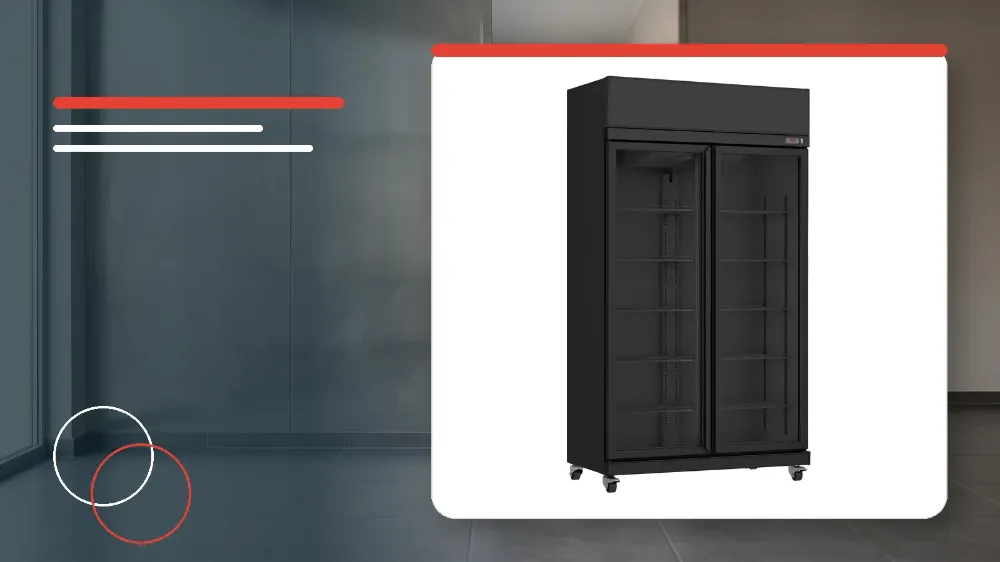
To troubleshoot the Combisteel 7455.3150 glass refrigerator, verify electrical connections and thermostat settings, clear debris from the condenser and grills, ensure the unit is levelled, relocate the cabinet from direct sunlight, reposition misplaced drain hoses into the drain pan, and escalate unresolved cooling issues, damaged cords, or persistent E0 and E1 controller codes to an authorised technician.
Applies to
This troubleshooting guide applies directly to the Combisteel 7455.3150 commercial glass door refrigerator.
Before you start
- Before cleaning or inspecting the appliance, always disconnect the power cord plug from the wall outlet to prevent electrical shock hazards or injury from the rotating circulation fan.
- Ensure the installation site allows all feet to make firm contact with the floor to prevent operating noise and poor door alignment.
- Confirm that ventilation grilles and the condenser location are free from external obstructions and debris.
- Ensure that any maintenance or well-keeping tasks beyond routine operator checks are assigned strictly to professional personnel.
Safety warnings
- Do not splash water directly onto the cooler and do not wash it with water, as short-circuiting and electrical shock could result.
- Never use polishing powder, soap powder, gasoline, oil, or hot water on the unit because these substances will damage painted surfaces and plastic components.
- Do not damage the refrigerant circuit, and never use mechanical devices or other artificial means to accelerate the defrosting process other than those recommended by the manufacturer.
- For units using R290 refrigerant, the power supply must be stopped first before any maintenance, and LED lights must not be replaced by yourself but by professional maintenance personnel.
Electrical Supply and Non-Operation Diagnostic Checks
When the unit is not operating, the issue is typically caused by faulty electrical contact, poor electrical power, or a thermostat set to the minimum position.
Faulty electrical contact or improper seating in the wall outlet will prevent the unit from receiving required electrical power.
If the thermostat dial is resting at the minimum position, the refrigeration system will not initiate cooling.
- Verify all electrical connections to eliminate faulty electrical contact.
- Check the main power connection and verify that the electrical outlet provides adequate power.
- Adjust the thermostat setting to a higher number if it is currently set to the minimum position.
- Call an authorised service agent if the unit continues not to operate after checking electrical power and adjusting the thermostat.
Addressing Temperature Deficits and Poor Cooling Performance
A unit failing to reach the desired temperature may suffer from sunlight exposure, improper thermostat settings, poor door closure, overloaded products, a clogged condenser, or blocked grills.
Direct sunlight exposure introduces excessive radiant heat that prevents the cabinet from maintaining desired internal temperatures.
Poorly distributed products or an excess product load inside the cabinet restricts the internal circulation of cold air.
Doors that are not properly closed allow ambient heat to enter, which requires checking both unit levelling and the door seal.
A clogged condenser or ventilation grills blocked with debris will prevent adequate heat dissipation and impair refrigeration efficiency.
- Relocate the unit to a shaded area if it is currently exposed to direct sunlight.
- Adjust the thermostat setting to a higher number if the temperature is not properly regulated.
- Check the levelling of the unit and inspect the door seal to ensure the doors close properly.
- Redistribute the product load according to start instructions to correct poor distribution or excess product volume.
- Clean the condenser and clean the grills of any debris that has collected.
Electronic Temperature Controller Error Codes E0 and E1
On models equipped with an electronic temperature controller, the digital display alerts staff to system faults using specific alphanumeric codes.
When the electronic controller indicates error code E0 or E1, the operator must carry out an outlet power reset.
- Unplug the unit from the electrical outlet to perform an immediate controller reset.
- Plug the power cord firmly back into the dedicated outlet after disconnecting.
- Contact an authorised service technician if the controller continues to indicate error code E0 or E1.
Eliminating Excessive Operating Noise and Vibration
Excessive operational noise from the appliance is typically caused by improper levelling or loose external items contacting the cabinet.
When the cabinet is not properly levelled, mechanical vibration is amplified across the floor and exterior casing.
- Level the unit, making sure all the feet are in firm contact with the floor.
- Keep contacting objects, such as boxes, mops, and brushes, completely away from the appliance.
Correcting Water Pooling and Drainage Leaks
Water appearing on the floor around the cooler indicates an issue with the condensate collection system.
When the drain hose is positioned outside of the drain pan, defrost condensate drains directly onto the floor instead of collecting in the pan.
- Check the position of the drain hose relative to the drain pan beneath the appliance.
- Locate the drain hose back inside the drain pan so all condensate discharges correctly.
Condenser Maintenance and Safe Cabinet Cleaning Procedures
Regular cleaning of the condenser and exterior surfaces ensures optimal refrigeration efficiency and prevents equipment failure.
Always disconnect the power cord plug from the wall outlet before cleaning to avoid electrical shock hazards or injury from the rotating circulation fan.
Never splash water directly onto the cooler and do not wash it with water, as short-circuiting and electrical shock could result.
Never use polishing powder, soap powder, gasoline, oil, or hot water on the unit because they damage painted and plastic components.
- Disconnect the power plug from the wall outlet before beginning any cleaning work.
- Clean the condenser and clear the grills of any debris collected.
- Wipe down cabinet surfaces without splashing water and without using polishing powder, soap powder, gasoline, oil, or hot water.
- After cleaning, confirm the power plug is firmly inserted into a dedicated outlet, check that it is not abnormally hot, and inspect the power cord for cracks and damage.
R290 Hydrocarbon Refrigerant and Electrical Safety Regulations
The appliance operates with flammable R290 refrigerant, requiring strict adherence to manufacturer safety boundaries.
Operators must never damage the refrigerant circuit during operation, cleaning, or positioning.
Never use mechanical devices or other artificial means to accelerate the defrosting process, other than those recommended by the manufacturer.
For any types of maintenance and well-keeping, the power supply must be stopped first, and professional personnel is required.
- Stop the power supply first before any maintenance or well-keeping is carried out.
- Ensure any R290 discharge is conducted only in a well-ventilated room or outdoors, and strictly prohibit open flames.
- Do not replace LED lights yourself, as they must be replaced by professional maintenance personnel.
Stop and get help if
- Stop operation and disconnect the appliance immediately if the power cord shows cracks or damage, or if the power plug feels abnormally hot.
- Stop operating the unit immediately if the refrigerant circuit is damaged or punctured.
- Halt operator troubleshooting if the electronic controller continues to display error code E0 or E1 after unplugging and reconnecting the unit.
- Stop all cleaning or maintenance if water has splashed into electrical sections, to avoid electrical shock or short-circuiting.
When to call an engineer
- Contact an authorised service technician if the electronic temperature controller continues to display error code E0 or E1 after unplugging the unit.
- Call the manufacturer, its service agent, or a similarly qualified person to replace a damaged supply cord in order to avoid a hazard.
- Contact the dealer from whom you purchased the unit if the power plug is abnormally hot or if any crack or irregularity is observed on the power cord.
- Call professional maintenance personnel whenever internal maintenance, well-keeping, or LED light replacement is required on R290 products.
- Call an authorised service agent if the refrigerator continues not operating or fails to reach desired temperatures after all operator checks have been completed.