


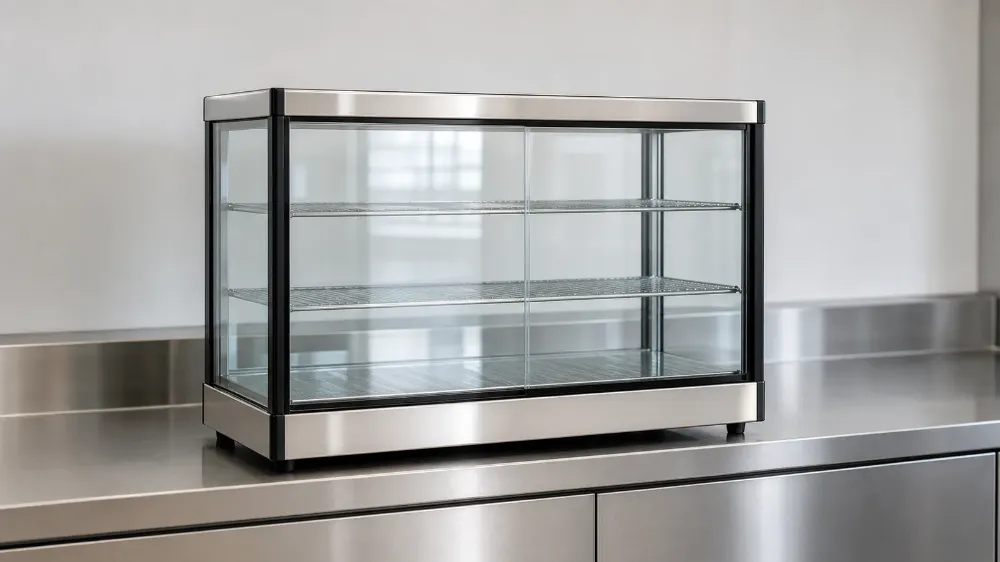
Short answer: If a Combisteel 7013.2570 is running but not cooling properly, check that it has power, remains free-standing with 10 cm clearance above, behind and at both sides, is away from sunlight and heat, is level, and has a tightly closed door. Then check the normal temperature setting using the operator controls. If those external checks do not change the situation, contact the local after-sales service centre rather than opening the refrigerator.
Start with safe external checks
The exact-product manual covers the Combisteel 7013.2570 Countertop Refrigerator. Its English troubleshooting table contains a mistranslated heading, so this guide does not repeat that label or use it as a diagnosis. It uses only the individual external checks that the manual clearly states.
- Confirm that the power is on. The manual asks the user to check whether power is available and requires the refrigerator to be connected to an exclusive, properly installed grounded wall outlet. Keep the grounding prong intact. Do not open the plug or socket, measure supply voltage or attempt wiring work. Questions about power or grounding should go to a certified electrician or an authorised service centre.
- Check the installation space. This refrigerator is free-standing only; it should not be recessed or built in. Keep 10 cm of space at the top, back and sides so air can circulate around the compressor and condenser. Do not block the ventilation openings.
- Check the room and nearby heat. Keep the unit away from direct sunlight, stoves, heaters, radiators and other heat sources. The manual also warns that extreme cold ambient temperatures may prevent proper performance and says to avoid moist locations.
- Check that the refrigerator is level and stable. The floor must be strong enough for the fully loaded unit. Use the levelling legs at the bottom to level it; do not tilt or dismantle the cabinet as part of troubleshooting.
- Check the door. Make sure it closes tightly. Avoid opening it frequently or leaving it open for a long time while assessing performance.
Allow the documented initial cool-down
After the appliance is first plugged into the wall outlet, the manual says to allow it to cool for 2–3 hours before placing food and drinks inside. This is an initial start-up instruction, not a general recovery time for every cooling complaint. The reviewed pages do not state how long an already loaded cabinet should take to recover after a door opening or setting change, so do not invent a waiting period.
If the refrigerator was only just installed or reconnected, keep it empty during that documented 2–3-hour initial cool-down. If it has already been operating and is still not cooling correctly, continue with the controller check and escalation boundary below.
Check the normal temperature controls
Use only the controls on the front panel:
- Press and hold the unlock key for two seconds to unlock the controls.
- Use the Add or Minus key for temperature setting. The manual identifies both keys for that purpose.
- Keep any selected value within the documented adjustable range of 3°C to 18°C. The manual does not prescribe one ideal setting for every product or site, so use the setting authorised by your operating and food-safety procedures.
The keys lock automatically after 20 seconds without operation. The manual does not give a separate save or confirmation instruction on the reviewed page, so this guide does not invent one. The control-panel display range of 0–37°C is not the same as the adjustable set-point range; the documented adjustable range is 3–18°C.
Do not use the controller as proof that stored food is safe. Continue to check actual product temperatures under your site’s food-safety system.
Understand the temperature display
In Celsius mode, when the temperature measured by the controller probe is within ±1°C of the set temperature, the display shows the set-temperature value. In Fahrenheit mode, it does this when the measured temperature is within ±2°F of the set temperature. This is documented display behaviour, not an independent measurement of every item inside the refrigerator and not proof that there is no internal fault. Keep using the monitoring method required by your site.
Stop and call an engineer when required
Stop the owner checks if the supply cord is damaged, the plug does not fit safely, the refrigerator is unstable, or the fault persists after the external checks. A damaged supply cord must be replaced by the manufacturer, its service agent or a similarly qualified person.
This refrigerator contains flammable R600a refrigerant. Keep it away from fire, do not damage or inspect the refrigerant circuit, and do not use mechanical devices to accelerate defrosting. Do not remove covers, access wiring or attempt compressor, condenser, fan or sealed-system work. The manual directs users to seek professional help when the machine breaks down.
If the situation cannot be changed, contact the local after-sales service centre promptly and provide the model name and product number. The checks above can rule out documented external conditions, but they cannot establish a remote diagnosis of an internal fault.
The source procedure is in the Combisteel 7013.2570 exact-product manual.