











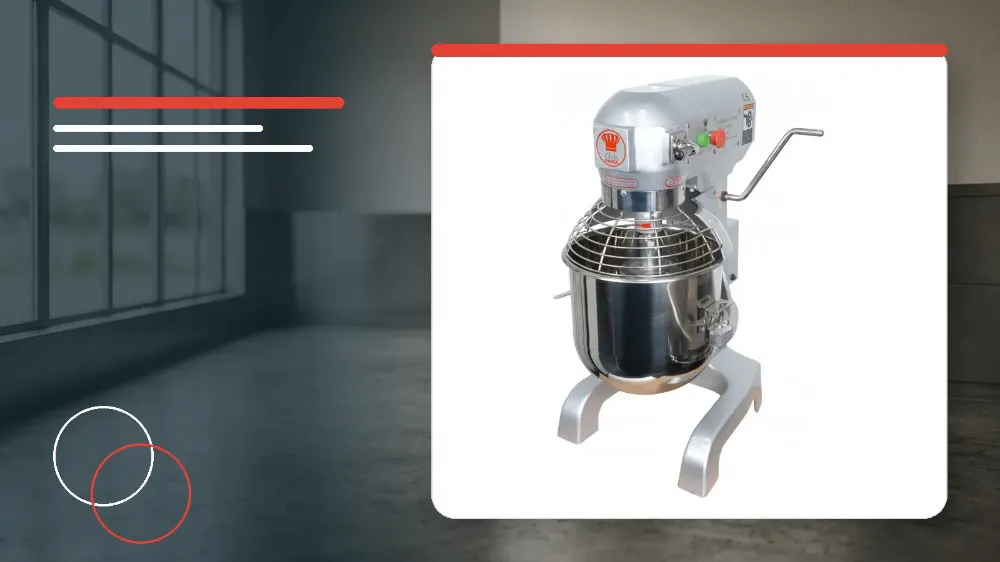
To prevent excessive motor temperature rise and below-speed operation on the Chefsrange GCAD20, operators must reduce the batch load, choose a suitable agitator, and ensure the working speed selected is not too high.
Applies to
This operational guidance applies specifically to the Chefsrange GCAD20 planetary mixer.
Before you start
- Ensure that the mixer bowl is lowered completely into the down position before attempting to mount or replace any agitator tool.
- Verify that your planned ingredient batch weight does not overload the mixer during production runs.
- Select the correct mixing attachment and appropriate operating speed suited for your specific recipe requirements.
Safety warnings
- Operating the machine under excessive overload will lead to excessive motor temperature rise and cause the mixer to run below its normal speed.
- Selecting a working speed that is too high or operating with an unsuitable agitator directly results in motor overheating and low mixing speeds.
- Failure to engage the agitator drive pin securely into the shank slot risks the agitator falling down while the machine is running.
- Operators must never open internal panels or carry out electrical voltage checks on the mixer supply.
Recognising and Remedying Mixer Overload
When a planetary mixer is packed with excessive ingredient mass, the mechanical resistance places excessive strain on the drive motor.
On the Chefsrange GCAD20, an overload condition manifests primarily as an excessive rise in motor temperature alongside a noticeable drop below normal operational speed.
Whenever an operator observes the mixer running below speed or detects excessive heat building up in the motor housing, the specified remedy is to reduce the batch load immediately.
Splitting larger batches into smaller portions alleviates strain and ensures the motor operates within safe thermal limits.
- Observe whether the mixer motor is running below its standard speed during mixing.
- Check if the motor temperature rise is too high during the production cycle.
- Reduce the quantity of ingredients in the bowl to alleviate the overload condition.
Matching Agitator Types and Operating Speeds
Incorrect pairing of mixing attachments and planetary speeds can severely impair mixer performance.
If a working speed is selected that is too high for the product density or if an unsuitable agitator is used, the motor will suffer excessive temperature rise.
This mismatch also causes the drive assembly to run below its intended operational speed.
Operators must resolve this issue by selecting a suitable agitator and operating at a compatible working speed.
- Evaluate whether the chosen working speed is too high for the ingredients in the bowl.
- Verify that the fitted agitator is suitable for the current mixing process.
- Select a suitable speed and agitator combination to return the motor to standard running conditions.
Correct Agitator Assembly Procedure
Proper mechanical attachment of the agitator ensures safe running and avoids physical dislodgement during rotation.
When assembling an agitator on the Chefsrange GCAD20, the bowl must always be placed into the down position first.
The operator must slip the agitator upward onto the drive shaft and rotate it until the shaft driving pin seats fully into the L-shaped slot located in the agitator shank.
Securing the pin inside this L-shaped slot is essential to avoid the agitator falling down while the mixer is running.
- Lower the mixer bowl completely so that it rests in the down position.
- Slip the selected agitator straight up onto the central drive shaft.
- Turn the agitator until the driving pin in the shaft engages fully into the L-shaped slot of the agitator shank.
Stop and get help if
- Stop mixer operation immediately if the motor temperature rise remains too high after reducing the batch load and correcting the speed and agitator selection.
- Stop the machine immediately if the agitator becomes disengaged from the drive pin during running.
When to call an engineer
- Request a qualified service technician to check the electrical supply voltage if the motor continues running below speed or overheating when load and agitator settings are correct.
- Escalate all supply voltage checks and incoming electrical testing to a qualified service professional.