


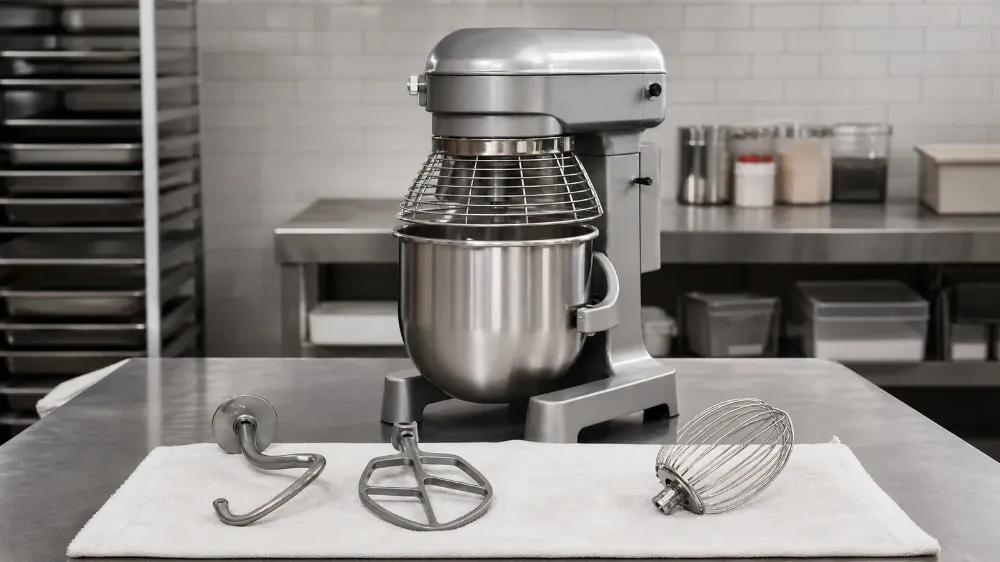
Use the dough arm at low speed for heavy bread dough, the beater at middle speed for thin batters, cakes and mashed-potato-style mixtures, and the wire whip at high speed for whipping cream or beating eggs. Stop the AD10 before every speed change, and never mix dough at middle or high speed. The locked pilot safety boundary also requires the mixer to remain stopped whenever an attachment is changed or handled.
Attachment and speed guide
| Job | Attachment | Manual speed guidance |
|---|---|---|
| Heavy bread dough | Dough arm | Low speed |
| Thin batters, cakes and mashing potatoes or similar stuffing | Beater | Middle speed |
| Whipping cream and beating eggs | Wire whip | High speed |
The technical table for the GCAD10-series machine lists three mixing speeds: 110, 178 and 355 r/min. The operating notes describe attachment choices by the labels low, middle and high; use the machine's labelled speed positions and do not invent an alternative speed for an attachment.
Dough limits
The AD10 technical table gives a 10-litre bowl volume and a maximum kneading capacity of 2 kg. Do not exceed that stated maximum. For the heavy-bread-dough guidance, the manual describes water at 47% to 50% of the flour weight and says the flour weight is indicated by the mark. Recipe formulation and actual batch suitability still need to follow the approved kitchen recipe; the manual's percentage is not permission to overload the mixer.
Dough must stay at low speed. If the mixer is overloaded, use a smaller load. If the selected speed is too high or the agitator is unsuitable, stop and select a suitable speed and agitator; never correct dough mixing by moving to middle or high speed.
Change an attachment safely
- Stop the mixer fully before changing speed. As a locked safety boundary, also keep the mixer stopped whenever an attachment is changed, fitted or removed.
- Rotate the hand wheel to lower the bowl. The manual says the bowl must be lowered to change an agitator or to remove the bowl or agitator.
- With the bowl in the down position, slip the agitator up onto the shaft and turn it until the driving pin in the shaft reaches the L-shaped slot in the agitator shank. This seating step is intended to prevent the agitator from falling during operation.
- When ready to mix, rotate the hand wheel to raise the bowl until you feel it touch the stop.
- After mixing, rotate the hand wheel to lower the bowl before removing the bowl or agitator. As a locked safety boundary, keep the mixer stopped throughout attachment handling.
If the attachment will not seat at the driving pin and L-shaped slot, do not start the mixer; lower the bowl and have the fit checked.
Choosing correctly rather than compensating with speed
Use the attachment that matches the job. The beater is the documented choice for thin batters, cakes and mashing potatoes or similar stuffing, while the wire whip is for cream and eggs. Neither replaces the dough arm for heavy bread dough. Do not compensate for an unsuitable attachment or excessive load by selecting a higher speed.
When to stop and call for service
Stop if the agitator knocks against the bowl or if the agitator or bowl is deformed. Serious gearbox noise or excessive temperature also requires a stop and the approved service route. Do not follow internal electrical, motor, voltage, wiring, gearbox or oil-seal repair steps. Those checks are outside trained-operator scope.